

The Ethereum Layer-2 protocol known as Kinto has officially announced that it will cease operations on September 30, as a result of a catastrophic exploit that occurred on July 10 that resulted in the draining of 577 ETH (approximately $1.55 million).
The hack sent its native token, $K, into a freefall, where it lost over 81% of its price just days following the exploit.
Once touted as a “modular exchange” aimed at institutional and sophisticated traders, Kinto marketed itself heavily based on its compliance features, including KYC integration, anti-money laundering measures, and passkey authentication.
However, the exploit proved to be fatal for the protocol, compromising both its credibility and its finances.
Founder Outlines Controlled Shutdown and Restitution Plan
In a formal statement, Kinto founder Ramón Recuero explained a “controlled shutdown” procedure to affect users’ partial refunds.
This process made it clear that the remaining foundation assets will be returned to Phoenix lenders, who are expected to recover, on average, about 76% of their principal.
He further stated the following: “In addition to the process above, I will match funds personally to offer an additional $55,000 to reimburse Morpho / Defi users with bad debt because they were figure victims of the attack, up to $1,100 maximum per address”.
Moreover, if any stolen funds are recovered, the victims maintain the intent for future compensation on the debts to alleviate the impact of the bad debt.
While the structured return represents a limited remediation option for impacted users, Recuero suggested that the outcomes were the best he could do with the dwindling protocol’s available reserves.
Exploit Exploited Known Vulnerability and Crippled Operations
The July attack happened after an attacker took advantage of an old vulnerability that the Kinto team had no time to fix.
According to Rekt News reports, the attacker minted 110,000 counterfeit Kinto tokens on the project’s Layer 2 powered by Arbitrum and dumped them into liquidity pools.
Then, they siphoned funds from a Morpho lending vault and a Uniswap v4 pool.
The incident happened within a few hours of the vulnerability being publicly pointed out, and the Kinto team was unable to react.
Not only did the attack rob many millions from the project, but it also weakened trust in their security and governance.
Also Read: Nemo Protocol On Sui Network Hacked For $2.4 Million Loss, Hacker Converts USDC To Ethereum
Failed Recovery Attempt Through Phoenix Initiative
In the wake of the exploit, the Kinto team launched “Phoenix,” a recovery effort designed to raise $1 million and relaunch the protocol. The plan was to relaunch a new token mapped to pre-hack balances and to refill liquidity pools to enable trading and DeFi activity.
However, Phoenix encountered insurmountable obstacles: the recovery loans had added even more debt that ultimately locked the door on new financing.
With no capital available to begin rebuilding the ecosystem, Phoenix fell apart, and Kinto was required to pivot to closing everything down completely.
Also Read: Fortune Collective Founder Alexander Choi Suffers $996,000 Crypto Hack Via Video Call Crypto Scam
Token Plummets 82% in 24 Hours, Market Cap Under $1M
Due to the aftermath of the hack and of the ineffectual recovery, the value of the Kinto token ($K) has dropped to essentially nothing.
As we examine the current price, the $K is trading at $0.4204 and has a 24-hour trading volume of just over $404,000.
In the past 24 hours alone, the token has dropped a whopping 82.26%, and that figure is even more staggering at -87.22% over the past week.
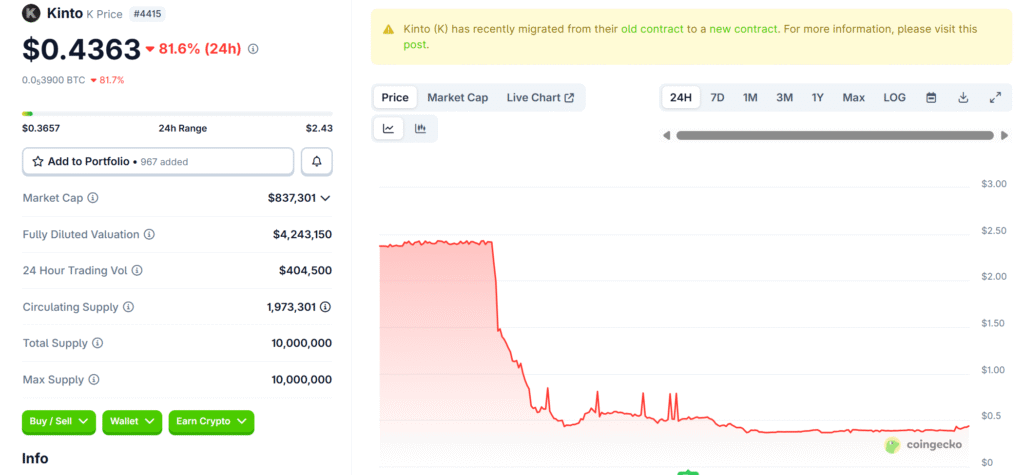
Kinto has a circulating supply of only two million tokens, and now has a market cap of just $836,891, clearly not what the founders envisioned when this token was intended to be a DeFi protocol that would be compliant and institution-ready.
The demise of Kinto is yet another cautionary tale about the reckless and foolish nature of cryptocurrency and how an exploited vulnerability or ill-fated recovery can cause a project to become lifeless and forgotten, almost as fast as it became livelier than ever.
Wider Trend of Crypto Hacks Raises Alarms
Kinto’s demise adds to the pile of recent, visible attacks that have created doubt in the enhancement of DeFi security. On June 21st, we reported that Hacken Token ($HAI) fell over 97% in value after a recent security incident.
On September 1st, UnoCrypto reported that Olaxbt lost $2 million, after $32 million $AIO tokens were drained from multisig wallets.
Earlier today, there was a $2.4 million exploit involving Nemo Protocol on the Sui Network, where hackers exchanged USDC for Ethereum.
Altogether, these examples exemplify that DeFi protocols are losing their invulnerability. August 2025 alone recorded crypto losses in excess of $163 million, according to UnoCrypto.
While Kinto’s demise is a tragedy, it shows a wider validity problem for the industry as a whole to secure decentralized environments from an increase in attack sophistication.
Also Read: Hacken Token ($HAI) Gets Targeted in Latest Crypto Hack, Leading to Steep Price Drop of Over 97%