
Monero (XMR), one of the active and one of the top privacy-focused cryptocurrencies, has increased by more than 6% in the past 24 hours, after having suffered a security incident involving an 18-block reorg.
The reorg happened at 5:12 am UTC on Sunday, reversing approximately 117 transactions and ending at block 3499676, 43 minutes later.
The attack was premeditated by Qubic, which is a layer-1 blockchain and mining pool that also obtained more than 51% of Monero’s hashrate, allowing it to change significant portions of the Monero ecosystem.
The researchers have at least confirmed the event, including Rucknium on GitHub. This is being labelled the largest reorg that Monero has ever experienced.
Market Reaction Defies Security Breach
Incredibly, Monero’s price did not plummet during the reorg, but it held steady and quickly went up after it.
According to information from CoinGecko, Monero gained 7.4% in value after the incident, climbing from $287.54 to $308.55 just eight hours later.
As of the time of report, Monero is trading at $304.57, with a 24-hour trading volume of $90.1 million and a market cap of $5.6 billion.
That comes out to a 6% daily gain and nearly 12% gain over the last week, even with growing concerns over the reliability of the network.
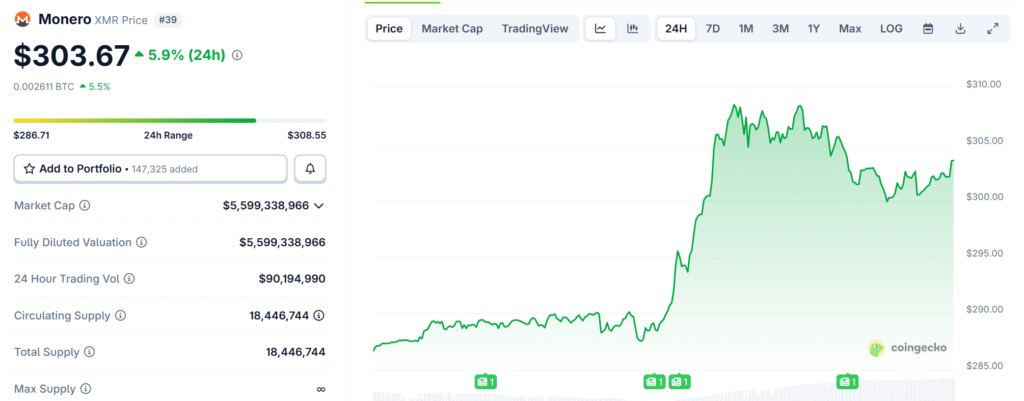
The price action still says traders have some confidence that has not been shaken, as the community suffers directly from some serious security issues.
Also Read: Founder of Mask Network Suji Yan Suffers Major Crypto Hack, Loses $4 Million In Stolen Assets
Community Divided on Network Reliability
The reorganization has generated considerable debate within the Monero community and among those watching from the sidelines about the longevity of the project.
Crypto podcaster Xenu, one of the earliest reporting parties of the attack, noted that Qubic may have been attempting to use the reorg in the hopes of creating an artificial price movement in XMR.
More importantly, some voices in the community have felt comfortable questioning whether the Monero network can remain a viable, trustworthy monetary network.
Vini Barbosa, an analyst, said that he would stop accepting payments in XMR until the situation improved. He claims that he has lost faith in the reliability of the chain.
The fact that multiple attacks took place exemplifies the susceptibility of proof-of-work blockchains when the network hash rate becomes too centralized.
Also Read: Nervos Network Faces Major Hack as Bridge Exploit Results in Over $3 Million in Stolen Assets
Centralization Versus Security Debate Intensifies
As a result of the situation, Rucknium and others have suggested Monero nodes using DNS checkpoints; essentially, nodes would get block data from community-managed DNS servers.
Some see this as a way to protect against additional reorgs, while others see it as a threat to the decentralization that is a pillar of Monero.
The situation has been compared to a “Sword of Damocles” hanging over Monero’s future. SlowMist Founder Yu Xian warned the community that if a solution was not brought forward, the Monero network would be vulnerable indefinitely.
The Qubic entity is still holding great power over the network, controlling more than 50 percent of the hashrate, and the decisions around security and governance are far from easy.
Exploring Solutions to Prevent Future Attacks
Monero has recently been the victim of Qubic’s control before: In August, the token dropped 13% when Qubic executed its similar 51% attack, putting fears of both double-spending and censorship to the forefront, according to UnoCrypto.
Since that time, the Monero community has had some conversations about different ways of having better defenses, including changing its proof-of-work algorithm, merging mining with other coins like Bitcoin, or using ChainLocks, which have been pioneered by Dash.
However, none of that has materialized into a solid implementation. The previous 10-block protection in Monero was useless and therefore did not stop the recent 18-block reorg attack, signifying the need for more valid solutions.
Monero is, for now, holding up its price quite well, but it goes without saying that there is more than fast-moving prices at stake. Its reputation as a secure and decentralized privacy coin is in its most serious test yet.
Also Read: Nemo Protocol On Sui Network Hacked For $2.4 Million Loss, Hacker Converts USDC To Ethereum


 rose more than 6% after suffering an 18-block reorg by Qubic, reversing 117 transactions and sparking debate over the network’s security and decentralization.)