
On August 12th, at press time, Monero (XMR) has suffered a sharp 13% price decline after the Qubic mining pool successfully executed a 51% attack on the privacy-focused cryptocurrency’s network.
The incident was first flagged by a user on X, “Caffeinated User,” who revealed that Qubic had achieved majority network control.
By holding over half of Monero’s total hashrate, Qubic can now orphan blocks from all other miners, effectively becoming the sole mining entity.
The move allows them to mine 100% of Monero’s daily blocks, equating to roughly 432 XMR, valued at $118,342.08 at current prices, and direct half the profits to miners while using the other half to buy and burn Qubic tokens.
In their own statement, Qubic hinted at calculated intentions, declaring that “the Monero $XMR experiment is proceeding exactly as planned.”
In total, this results in approximately $1.65 million worth of Qubic tokens burned every month, a strategic maneuver being hailed by some as historic, while alarming to many in the crypto community.
Security Threats and Network Implications
The development has attracted attention from many key industry members, Ledger CTO Charles Guillemet among them, who corroborated the successful attack and warned of its consequences.
Monero, in existence since 2014, with the best capabilities in privacy, is already out of reach on most major centralized exchanges due to regulatory scrutiny.
The Qubic pool’s majority control now enables it to reorganize the blockchain, facilitate double-spending, and censor transactions, capabilities that could undermine trust in the network almost overnight.
The cost of sustaining such an attack is estimated at $75 million per day, but the potential to monopolize block rewards and influence Monero’s future may outweigh the expense for Qubic.
Other miners are now left with no incentive to compete, given that Qubic can invalidate their efforts instantly.
Also Read: Crypto Hackers Exploit SuperRare Staking Contract Of $731K $RARE Tokens, Here’s All
Industry Response and Warnings from Security Experts
SlowMist founder @evilcos weighed in on X, stating that he had been monitoring the situation for some time and that the 51% attack on Monero “seems to have succeeded,” citing intelligence from the “black handbook” group.
While acknowledging the significant cost involved, he questioned the long-term economic benefit for Qubic, given the scale of resources required to maintain control.
However, @evilcos went ahead to stress the fact that Qubic may now rewrite Monero’s blockchain, double-spend, and censor transactions at will.
He further made a plea to exchanges, wallet providers, and other platforms to stay alert, given the potential threat posed to the users and the greater crypto ecosystem due to the ongoing attack.
Also Read: Microsoft Wipes Thousands Of North Korean IT Worker Fraud Accounts Amid Rising Crypto Hacks
Current Market Performance Amid the Attack
Despite the gravity of the situation, Monero’s price drop till now has been kept in the mid-teens.
Currently, the price of Monero is trading at $249.52, reflecting a 9% price drop in the last 24 hours. Also, a 16% drop has been recorded in the past week.
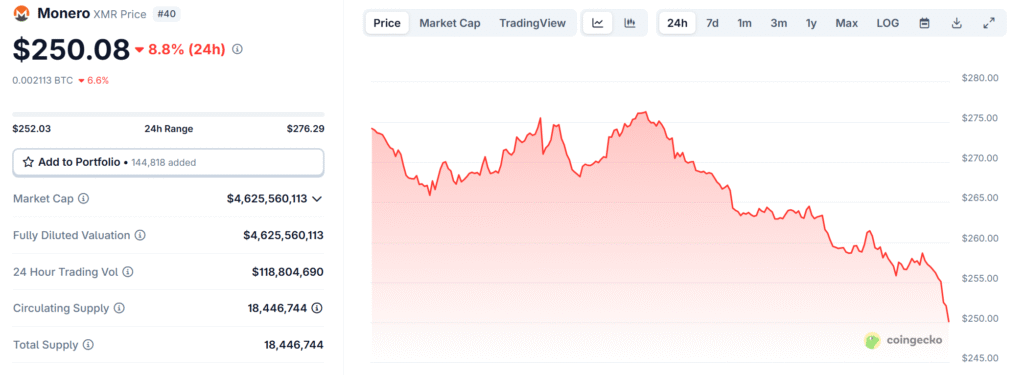
The 24-hour trading volume of XMR is $118.85 million, with a total circulating supply of 18 million XMR and a market cap of $4.63 billion.
Market analysts suggest that the current sell-off could accelerate if confidence erodes further, as the attack threatens the core integrity of the network’s decentralization and security.
Also Read: Fuzzland Reveals Former Employee Was Responsible for the $2 Million Bedrock UniBTC Crypto Hack
Growing Pattern of Crypto Exploits Raises Alarms
The Monero hack occurred in the midst of other big-name security breaches in the digital assets world, accentuating that even the very networks trusted by most are not safe.
On 15th July, Arcadia Finance got exploited for $2.5 million through Rebalancer, with funds afterward routed through Tornado Cash and cross-chain bridges.
Less than a month earlier, it was revealed that Chinese mining pool Lubian was the victim of a theft of 127,000 BTC, amounting to $3.5 billion as per today’s valuations, in a hack concealed for four years, now recorded as the greatest crypto heist in history.
The call for urgent steps to be taken to bring forth stronger safeguards and more transparency to the blockchain infrastructure, with attackers keeping pace in evolving their strategies to exploit tech and governance weaknesses.
Also Read: Venus Protocol on BNB Chain Faces $2 Million Crypto Hack


 drops 13% after Qubic mining pool launches a successful 51% attack, seizing control of the network’s hashrate and raising concerns over decentralization, double-spending, and censorship risks.)