

Ukraine’s parliament, the Verkhovna Rada, has moved closer toward defining the future of digital assets as it approved the first reading of a bill seeking to legalize cryptocurrency and regulate taxes.
After being announced by legislator Yaroslav Zhelezniak, the bill had a wide approval by 246 lawmakers.
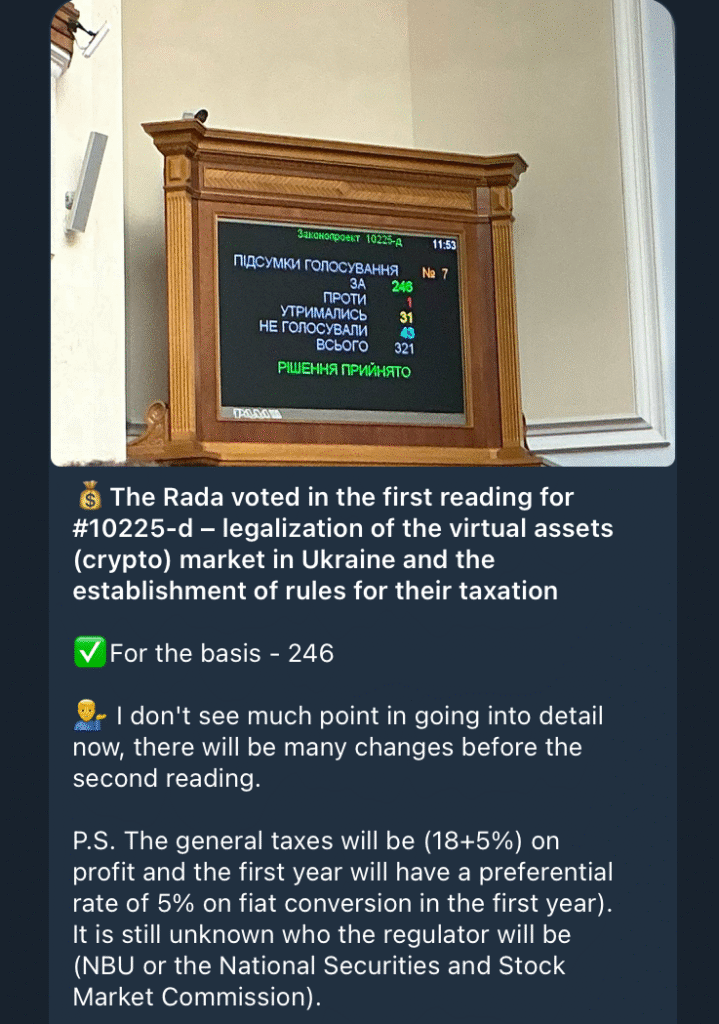
If passed, the bill will lay out a framework for regulating cryptocurrency in addition to establishing taxes on income earned from individuals trading and investing in cryptocurrency assets.
This comes as Ukraine maintains a position among the global leaders of crypto adoption, as many citizens are treating non-traditional financing methods, including crypto, as part of a typical daily economic activity.
Proposed Tax Outlines Include Military Tax and Good Rate
The draft bill will propose a tax structure that identifies the best tax to be 18% tax on income from crypto (sales), with an additional 5% military tax, for an effective tax rate of 23%.
For the first year, however, along with the proposed tax scheme, the bill has included a preferential 5% tax on exchanges when converting crypto into fiat.
This would help to promote compliance during the transition to a regulated tax system.
This scheme mirrors suggestions made by Ukraine’s financial regulator (to exempt crypto-to-crypto transactions and stablecoins) in order to make Ukraine’s tax regime be in line with other crypto-friendly jurisdictions.
Also Read: Russia Bans Crypto Mining In Occupied Ukraine Regions Amid Energy Crisis
Regulatory Oversight Still Under Consideration
Even with the advancements made so far, several components of the bill remain unresolved, including the authority that will oversee crypto market regulation.
Zhelezniak stated that it remains unclear whether the authority will fall to the National Bank of Ukraine (NBU) or the National Securities and Stock Market Commission (NSSMC).
He also reiterated that a considerable number of amendments will be introduced prior to the second reading.
The discussions about which authority is better positioned to be the lead regulator highlight the difficulty legislators experience in managing investor protections, oversight of financial services, and the perspective of the impact on innovation for markets.
Also Read: Ukraine Poised To Legalize Cryptocurrency By Early 2025, Details Inside
Ukraine’s Growing Crypto Ecosystem and Strategic Ambitions
The latest news builds upon a number of recent legislative activity from Ukraine that aims to expand the country’s crypto infrastructure.
Lawmakers proposed a bill in June 2025 that would allow the central bank to hold Bitcoin and other digital currencies as part of the national reserves, according to UnoCrypto.
Ukraine’s ambitions are mirrored in the 2025 Global Crypto Adoption Index from Chainalysis, in which the country is ranked eighth in the world for competence level, and clearly leads in the total value of centralized transactions and DeFi activities.
Industry figures, like Volodymyr Nosov, chief executive officer of WhiteBIT, believe this regulation will pave the way for foreign investment, as well as bring back to Ukraine some of the assets held outside the country by some of its users.
Also Read: Russian Citizen Gets 7-Year Jail Term For Cryptocurrency Support To Ukraine Military
Crypto Tax Policies Gain Momentum
Ukraine is taking these steps as part of a worldwide crackdown by governments to regulate and tax the use of cryptocurrencies.
Notably, in October 2024, Denmark proposed a tax on unrealized crypto profits, while Brazil recently announced a flat 17.5% tax on profits on cryptocurrencies, which ended tax exemptions that were previously in place.
In the United States, the discussion remains ongoing, with lawmakers exploring ways to establish frameworks to tax crypto in formal congressional hearings.
Ukraine’s pre-emptive measures place it in the group of countries that are attempting to balance managing the innovation of a new digital asset space while ensuring that tax revenue is also meeting national priorities, such as their military funding needs.