
In a landmark jurist ruling that can set the precedent for future prosecutions in the crypto industry, Roman Storm, Tornado Cash co-founder, has been convicted on one of three counts against him, which were brought before the Southern District of New York (SDNY).
Besides, Storm was convicted of conspiracies to operate an unlicensed money transmitting business, a federal crime that bears a penalty of five years maximum incarceration.
The trial commenced on the 14th of July, and sources noted that it saw three and a half days of deliberation by the jury.
Nevertheless, the jury could not arrive at a unanimous verdict on these other two harsher counts, namely conspiracy to commit money laundering and conspiracy to violate U.S. sanctions, hence rendering an incomplete prosecution of Storm at the moment.
Prosecution’s Bid to Remand Storm Denied by the Court
Following the guilty verdict, prosecutors moved swiftly to remand Storm into custody, arguing he was now a flight risk since he had a possibility of being sent to prison.
But U.S. District Judge Katherine Polk Failla rejected the motion, concurring with the defense’s argument that Storm’s close ties to America make him an unlikely flight risk.
Defense attorney Ms. Klein stated Storm’s $2 million bail is secured by his Washington State home, he has joint custody of his daughter, a long-term relationship in America, and family ties in the nation.
Judge Failla noted that the “stability of the verdict is still in play,” likely an appeal, and continued that while Storm’s motivations have shifted, she didn’t feel they warranted jailing right away.
Also Read: U.S. Court Reverses Sanctions Against Tornado Cash, $TORN Price Jumps 118%
Government Officials React with Strong Condemnation
U.S. Attorney for the SDNY, Jay Clayton, also released a statement following the verdict, describing the government’s belief that Tornado Cash actively encouraged widespread criminality.
“Roman Storm and Tornado Cash provided a service to North Korean hackers and other criminals to launder and hide more than $1 billion of dirty funds,” Clayton said.
He continued that while blockchain technologies like stablecoins have such exciting possibilities, they should not be used to conceal criminal activity.
But critics were quick to note that Clayton’s statement left out crucial context, such as the absence of proof that the majority of funds passed through Tornado Cash were illicit.
And his failure to address recent DOJ remarks that imply a reversal of the aggressive pursuit of crypto mixing services.
Also Read: Paradigm Backs Tornado Cash With $1.25M Legal Defense Fund Against DOJ Lawsuit
Tornado Cash Token ($TORN) Drops By 18% Amid Ruling
Storm’s conviction saw the marketplace react immediately and harshly. The $TORN token decreased in value by 17.88% in the past 24 hours, dropping to $10.27 at reporting.
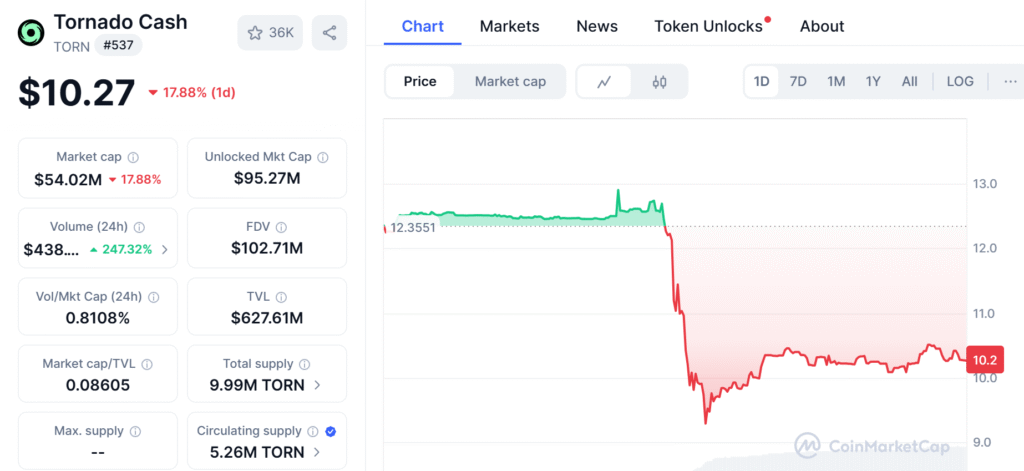
Its volume went up to $437,940, and now the project is valued at approximately $54 million, ranking No.537 on CoinMarketCap. The TORN token is noted to have a circulating supply of over 5.2 million $TORN tokens.
The sharp decline in the token’s price signals shaken investor confidence, which was somewhat expected given the volatility of the market in tandem with key fundamental news.
Also Read: DOJ Drops Part of Tornado Cash Case as Trump-Era Crypto Leniency Grows
Legal Ruling Sparks Ongoing Uncertainty About Crypto Regulation
Storm’s conviction on the guilty finding may be the turning point for the crypto world, particularly as regulators and law enforcement agencies are still trying to wrap their heads around decentralized technology.
Tornado Cash, which offers privacy-based services through coin-mixing protocols, has long been controversial due to the risk of its use by malicious actors, but several operators in the crypto universe are adamant that it is an apolitical tool, like encryption software.
The Department of Justice previously indicated it would pull back from “regulation by prosecution,” namely when it comes to targeting crypto platforms for nothing more than the behavior of end-users.
But the Storm case raises concerns that this policy shift has yet to fully come about.
While Storm prepares to appeal, the cryptosphere will be watching closely as to how the legal apparatus approaches privacy-facilitating tech and the people behind them.