
The Ethereum network is experiencing a significant shift in its gas limit governance, with validator support for higher gas limits reaching a notable milestone.
Currently, 10% of network validators are advocating for an increase in the gas limit to exceed 30 million units, marking a substantial rise from the mere 1% support observed before December.
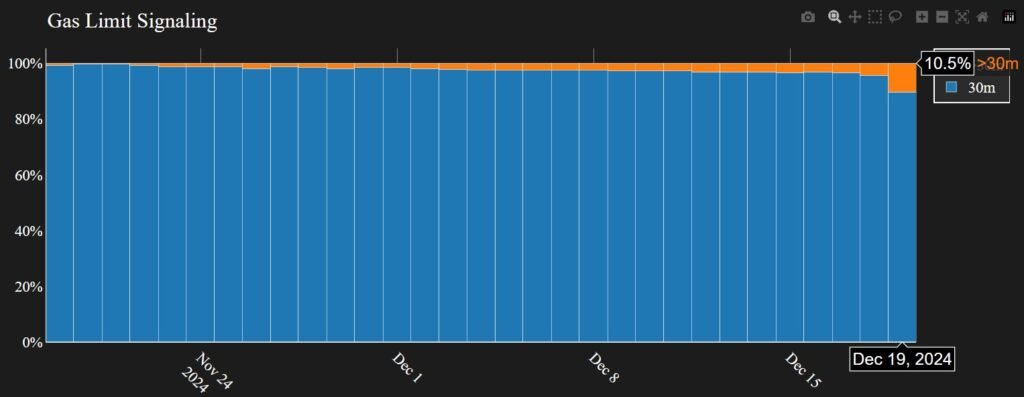
This growing consensus among validators represents a crucial development in Ethereum’s ongoing efforts to optimize its transaction processing capabilities and network efficiency.
The surge in validator support indicates an increasing recognition within the Ethereum community of the need to address transaction capacity and cost issues.
Proposed Changes and Expected Benefits
The proposed gas limit reforms have garnered attention from prominent figures in the Ethereum ecosystem, particularly due to their potential impact on transaction costs.
Core developer Eric Connor has projected that implementing the increased gas limit could result in a significant reduction in Ethereum transaction fees, ranging from 15% to 33%.
This projection has been further substantiated by the launch of the “Pump The Gas” initiative on March 20th, a collaborative effort between Connor and former MakerDAO smart contracts head Mariano Conti.
Their website advocates for an ambitious increase in the gas limit to 40 million units, presenting a comprehensive case for how this adjustment could meaningfully reduce layer-1 transaction costs.
The initiative has actively sought support from various stakeholders, including solo stakers, client teams, pools, and community members.
Technical Perspectives and Community Response
The technical discourse surrounding the gas limit increase has been enriched by contributions from prominent Ethereum researchers.
Justin Drake, a notable figure in the Ethereum research community, has taken a proactive stance by configuring his own validator for a 36 million gas limit.
Drake’s perspective emphasizes that a 20% increase could “safely grease the wheels” of the network, suggesting a balanced approach to scaling.
However, this enthusiasm is tempered by cautionary voices within the community who have raised concerns about the potential risks of rapid gas limit increases.
These critics emphasize the need to carefully evaluate the impact on network stability and decentralization, highlighting the delicate balance between improving network efficiency and maintaining system integrity.
Broader Context and Leadership Perspectives
The gas reform discussion exists within a broader context of Ethereum’s ongoing development and governance philosophy, particularly highlighted by recent contributions from co-founder Vitalik Buterin.
Buterin’s recent proposals and perspectives demonstrate the network’s commitment to maintaining decentralization while pursuing innovations.
His introduction of the “Deep Funding” concept, which combines value maps with refined human judgment, exemplifies the ecosystem’s approach to complex governance challenges.
Furthermore, Buterin’s explicit rejection of proposals for centralized committees reinforces Ethereum’s core commitment to verifiability and democratic participation.
These philosophical stances provide important context for understanding how the gas reform proposals align with Ethereum’s broader development trajectory and its fundamental values of decentralization and community-driven governance.
Also Read: Ethereum Co-Founder Vitalik Buterin Pushes Back on Plans to Reduce Decentralization, Here’s Why