
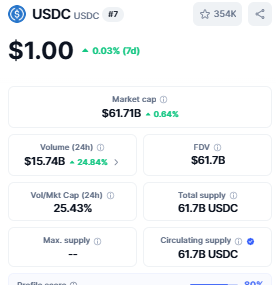
Circle, the issuer of the popular U.S. dollar-pegged stablecoin USDC, achieved a market capitalization of $63.89 billion, surpassing the total circulating supply of USDC, which stands at approximately $61.68 billion, as of Monday’s market close.
This development highlights growing investor confidence in Circle as a key infrastructure provider in the digital asset space, beyond just its role in managing stablecoin issuance.
Circle’s Market Cap Surpasses USDC Supply, Reflecting Broader Ecosystem Value
The fact that Circle’s market cap now exceeds the supply of USDC suggests that market participants are valuing the company for its broader ecosystem. This includes partnerships, compliance frameworks, and expansion plans into traditional finance and cross-border payments.
It also reflects expectations around Circle’s potential future revenue streams, particularly as USDC continues to gain traction in decentralized finance (DeFi), global remittances, and enterprise payment systems.
This milestone comes at a time when regulatory clarity around stablecoins is gradually improving in several jurisdictions, strengthening Circle’s position in the market.
As stablecoins become increasingly integrated into mainstream financial systems, Circle’s valuation indicates growing recognition of the pivotal role issuers play in shaping the future of money.
Investors appear to be betting not only on USDC’s growth but on Circle’s long-term leadership in the regulated digital currency space.
Also Read: Circle Teams Up with OpenPayd to Streamline $130B in Fiat to Stablecoin Transactions
Circle Milestone Signals Rising Investor Confidence Beyond USDC
The milestone marks a major milestone for Circle, signaling growing investor confidence in its long-term value beyond just issuing USDC.
With its market cap now exceeding the circulating supply of USDC, Circle is being recognized not only as a stablecoin issuer but as a key player in digital finance infrastructure.
This shift reflects the market’s belief in Circle’s broader role in global payments, compliance, and blockchain-based financial services.
It also strengthens the company’s position as a trusted, regulated entity in the evolving stablecoin landscape. As regulatory clarity improves and institutional adoption grows, Circle’s rising valuation highlights its potential to bridge traditional finance and digital assets—solidifying its leadership in the future of global money movement.
Also Read: Circle’s IPO Sends Co-Founder & CEO’s Wealth Past $1.7 Billion, CRCL Market Cap Crosses $16B
Circle Stock Surges Near $300 Before Closing at $263.45
Circle’s stock experienced a significant surge during intraday trading, with its price briefly approaching the $300 mark before settling at $263.45 by market close.
The spike reflects growing investor enthusiasm and confidence in Circle’s expanding role in the digital asset ecosystem, particularly as the issuer of USDC, one of the most widely used stablecoins.
This momentum was likely driven by the company’s strong market position, increasing institutional interest in regulated stablecoins, and broader optimism around digital finance infrastructure.
The sharp movement also suggests that market participants view Circle not just as a stablecoin issuer, but as a major fintech innovator with long-term value potential. The closing price positions Circle among the top-valued crypto-native firms in the public market.
Ark Invest Offloads Circle Shares Despite Robust Trading
Cathie Wood’s ARK Invest has begun trimming its stake in Circle following the company’s sharp post-IPO rally.
Previously, ARK Innovation ETF (ARKK) sold 415,855 Circle shares worth approximately $109.6 million, marking the third sale in just one week.
Additionally, ARK offloaded Circle shares valued at around $146 million, though it still remains one of the company’s top ten shareholders. The move appears to be part of a broader portfolio strategy to lock in gains, as Circle’s stock surged past $260.
ARK is reportedly reallocating capital into other tech and fintech plays such as Coinbase and Robinhood, signaling a shift in focus while still maintaining exposure to the digital asset ecosystem.