


In a landmark fusion of blockchain innovation and state-led development, the Central African Republic (CAR) has announced plans to tokenize more than 1,700 hectares of land using its official meme coin, $CAR.
President Faustin-Archange Touadéra revealed the initiative through a presidential decree shared on X (formerly Twitter), positioning the project as a transformative step toward modernizing land ownership.
Set to begin in June, the land tokenization will occur entirely online through the Solana blockchain, bringing new levels of transparency, security, and accessibility to land transactions in the country.
The president called it “a new era of access and transparency,” framing it as a major advancement in national digital infrastructure.
Tokenized Land Near Bangui May Have Strategic Mining Value
The 1,700 hectares designated for tokenization lie near the village of Bossongo, about 45 kilometers west of the capital, Bangui.
According to the presidential decree, the land tokenization process aligns with CAR’s 2023 legislative framework on natural resource tokenization and references the nation’s mining code.
This has led to speculation that the land could be allocated for mining operations, including exploration of gold and diamonds.
The region has a complex mining history, including involvement from external actors like Russia’s Wagner Group.
By using blockchain to oversee resource-linked land sales, CAR aims to improve governance and attract responsible international investment while mitigating past risks of opacity and mismanagement.
Also Read: Real Estate Tokenization Platform Alt DRX Secures $2.7 Million In Pre-A Funding
A Strategic Pivot: From Meme Coin Mayhem to National Utility
President Touadéra’s latest move represents a significant policy shift that redefines the role of the $CAR token within national governance.
Once dismissed as a short-lived meme coin, $CAR is now being rebranded as a functional state-backed digital tool. Touadéra’s declaration, “Some documents don’t just make laws.
They make history!”, underlines his vision of blockchain as a pillar of national development.
Although $CAR initially launched in February 2025 via the Solana-based Pump.fun platform and briefly skyrocketed to a $527 million valuation, it quickly crashed by 88% amid scrutiny and legitimacy concerns.
The land tokenization effort appears to be part of a broader rehabilitation strategy aimed at restoring public trust and demonstrating tangible utility for the token.
Also Read: Tokenization Firm Libre Brings Telegram Debt to TON with $500M Bond Fund
Past Controversies Cast Long Shadows on the $CAR Project
Despite the current surge in value and the presidential backing, $CAR’s past controversies continue to raise caution.
In February, its explosive rise from $0 to over half a billion dollars in market value, followed by an 88.7% crash within 24 hours, sparked industry-wide skepticism.
Many in the crypto community questioned the token’s legitimacy, concerned it might be another scam exploiting the meme coin trend.
The rapid valuation changes, combined with a lack of transparency at launch, severely dented its credibility.
However, with the current decree tying $CAR directly to a state land initiative and embedding it in national policy.
The Central African Republic is now attempting to distance itself from that chaotic beginning and establish $CAR as a cornerstone of its blockchain-driven governance model.
$CAR Token Surges as Market Reacts to Tokenization Decree
Following hints of the project earlier in the week, the $CAR token saw an immediate and sharp surge in value.
Climbing from around $0.025 to over $0.053424 within hours of the announcement, the token recorded a 20% gain and reached a market capitalization of over $53.4 million.
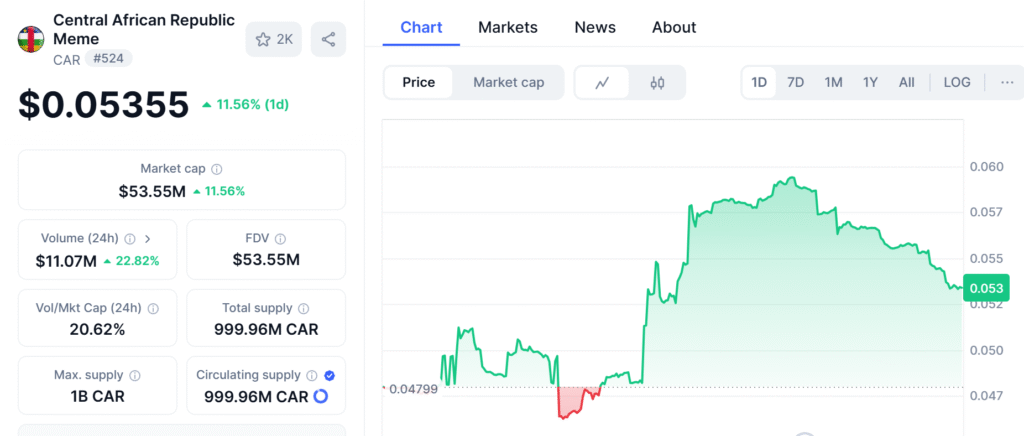
Trading volumes also spiked above $11 million in 24 hours, indicating strong market interest and investor optimism.
With nearly 1 billion tokens in circulation, $CAR has begun to evolve beyond its origins as a meme coin, gaining perceived legitimacy as a digital asset with real-world application.
The latest momentum suggests that investors are beginning to view $CAR as a governance and utility token central to CAR’s national digital policy.
Also Read: Ripple’s Custody Push Signals Long-Term Tokenization Strategy, Says Lawyer