
In a very crucial institutional crypto investing update, the Chicago Board Options Exchange (Cboe) has officially filed to list shares of Canary Capital’s proposed staked Injective (INJ) exchange-traded fund (ETF).
The filing follows after Canary Capital earlier filed an S-1 registration statement with the U.S. Securities and Exchange Commission (SEC) on July 17.
The proposed ETF will offer exposure to Injective tokens and also receive staking rewards from securing transactions on an “approved staking platform.”
If approved, the fund would be the third staked altcoin ETF to trade in the U.S., after the just-approved staked Solana and staked Ether ETFs.
That represents an extension into a broader trend of legitimation of yield-generating digital assets in regulated markets.
Political and Regulatory Environment Shows Favorable Lean towards Crypto-Backed Funds
The filing comes at a more amicable crypto regulatory environment under President Donald Trump’s administration, one that has been more open to innovation in block- and chain-based investment products.
While the SEC has not formally confirmed the Cboe and Canary Capital filings, this routine procedural step typically begins counting down critical deadlines.
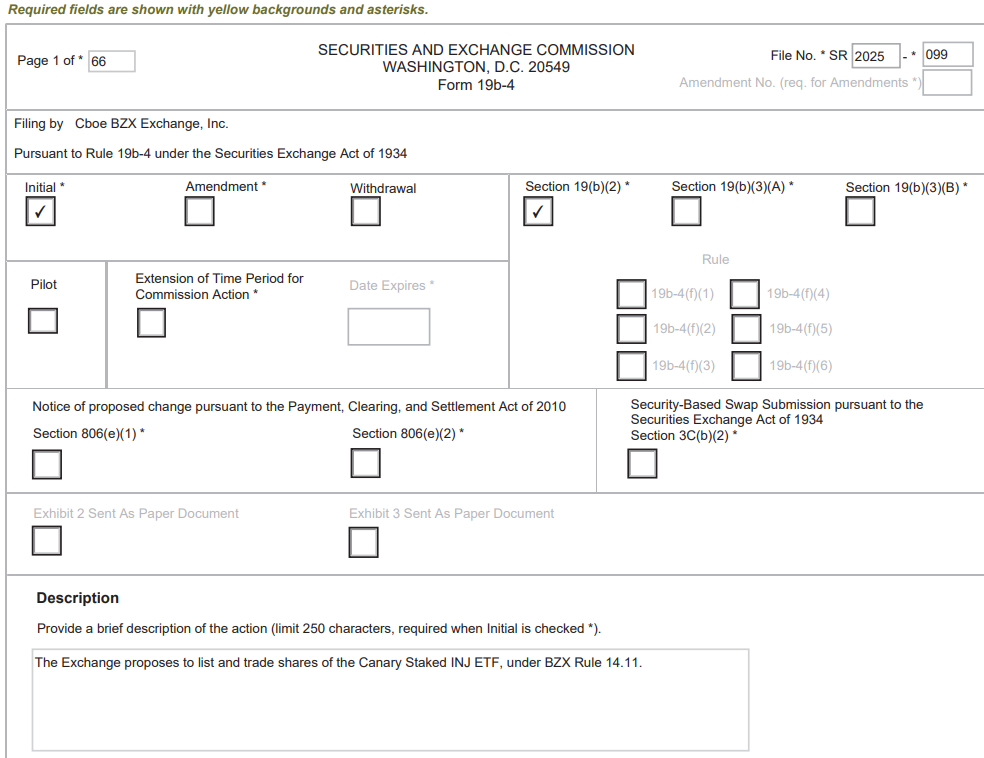
After being identified, the SEC would have an initial review period of 30 to 45 days, placing the initial window of response sometime early in September.
But the entire evaluation process would stretch as long as 240 days, sending a final ruling deep into March 2026.
Even with the timeline, however, regulatory momentum and political backing could make it more likely to achieve eventual approval.
Also Read: ProShares Secures NYSE Arca Approval for First Leveraged XRP ETF Ahead of Trading Launch Debut
SEC Staking Decision Paves the Way for Greater ETF Acceptance
A historic regulatory shift happened recently when the SEC last May decided that staking was not a breach of U.S. securities law.
The industry responded that the clarification was a seminal moment for the future of crypto investment vehicles.
As Alison Mangiero, staking policy leader at the Crypto Council for Innovation, explains, this ruling certifies that staking is a natural aspect of blockchain networks and not a typical investment contract.
The decision not only provides clarity in law but also opens the way for further staking-based ETFs, including the proposed staked Injective ETF, to introduce yield-generating digital assets to investors through traditional financial instruments.
Also Read: Solana ETF filings have disappeared from the Cboe website
Market data and Injective Token Performance in Light of ETF Frenzy
If it gets approved, the Canary Capital staked Injective ETF would definitely work to propel much more liquidity as well as institutional demand towards the Injective protocol governance token.
Through regulated exposure via an ETF, traditional investors will have a much easier route into the world of Injective; this should fuel fresh interest in the token.
Currently, Injective (INJ) is at $14.94, down 7.38% within the last 24 hours but only 3.26% up for the week past.
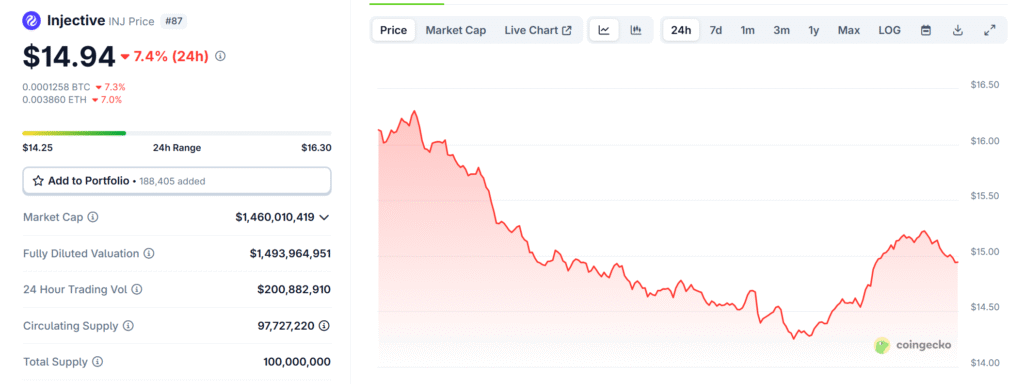
With 98 million circulating tokens and a market capitalization of approximately $1.46 billion, Injective is way off its all-time high value of $52 in March 2024.
The launch of an ETF can be a catalyst for price recovery, wider usage, and increased exposure to the Injective network among the overall market.
Also Read: Cboe Digital Seeks Regulatory Approval for New Bitcoin Futures Product Set to Launch on April 28