
The Astar Foundation has introduced a comprehensive proposal to overhaul the economic framework of its native token, ASTR, by transitioning from a dynamic inflation model to a fixed maximum supply of 10.5 billion tokens.
The strategic move is aimed at enhancing long-term economic value and sustainability within the Astar ecosystem. Under the new proposal, token emissions would no longer follow an inflationary trajectory.
Instead, a block-by-block emission decay mechanism would gradually reduce the supply growth over time.
The intention is to minimize network inflation while ensuring that core incentives remain intact, particularly for decentralized application (dApp) staking.
Over the next two years, Astar aims to stabilize the annualized dApp staking returns between 11% and 14%, in preparation for a broader brand and ecosystem upgrade.
Strengthening Tokenomics With Fee Burns and Sustainable Returns
Central to the proposal is a multi-pronged approach that goes beyond emission decay. The new model would burn 50% of all network transaction fees, effectively reducing the circulating supply and adding deflationary pressure to the token’s economy.
The recent development is designed to support ASTR’s long-term price stability and market appeal.
At the same time, 30% of transaction fees would be allocated to collators, entities that help secure the network, while the remaining 20% would be used for other protocol-level activities.
Astar intends for this structure to maintain robust network operations without overly depending on inflationary rewards, thus preserving ecosystem health amid broader shifts in the Polkadot network’s architecture, including the move toward Agile Coretime.
Also Read: Sony Launches Soneium Blockchain, Partners See Boost In Activity
Introduction of Protocol-Owned Liquidity for Network Autonomy
A key innovation in the proposal is the establishment of Protocol-Owned Liquidity (POL), a concept aimed at enhancing Astar’s financial autonomy.
Managed by the Astar Finance Committee (AFC), the POL strategy involves generating yield from network-held assets and reinvesting it into the Astar ecosystem.
Specifically, the protocol would use accumulated value to acquire DOT tokens, pair them with ASTR in liquidity pools, and self-stake to secure Polkadot parachain coretime, eliminating reliance on crowdloans.
The AFC plans to offer full transparency through monthly financial reports and a publicly accessible dashboard, ensuring accountability and community oversight as the new system is rolled out.
Motivations Behind the Shift and Industry Alignment
According to Astar Network’s official communications, the decision to adopt a fixed supply model aligns with industry trends favoring deflationary or capped supply structures for long-term token value.
Fixed supply is increasingly seen as a standard in blockchain economics, as it curbs inflation risks and attracts value-conscious investors.
The proposal also responds to changes in the Polkadot ecosystem, where self-financed security mechanisms are becoming essential due to the evolution of Agile Coretime.
Astar’s move reflects a broader effort to create a self-sustaining, transparent, and strategically guided network, positioning ASTR as a more resilient and attractive digital asset within the multichain ecosystem.
Market Response and Current ASTR Price Dynamics
Market participants have reacted positively to the announcement, with ASTR’s price increasing by 6.36% in the past 24 hours to $0.02843, despite a modest 7-day decline of 3.62%.
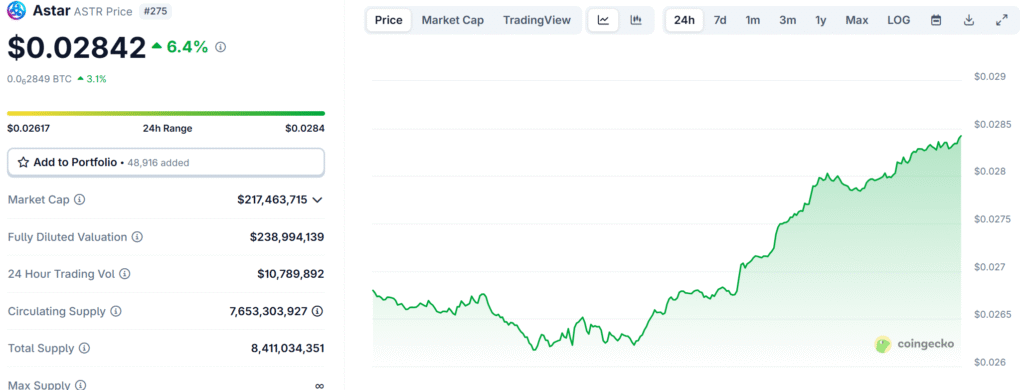
The token’s current market capitalization stands at approximately $217.4 million, based on a circulating supply of 7.7 billion ASTR.
Daily trading volume has reached nearly $10.8 million, reflecting renewed investor interest following the proposal.
While it remains to be seen how swiftly these changes will be implemented, the foundational shift in Astar’s economic design has already reignited momentum in the community and strengthened the network’s long-term value proposition.
Also Read: Meteora Proposes Allocating 25% of MET Token Supply to Liquidity Rewards and TGE Reserve