
The second-largest cryptocurrency, Ethereum, despite being called the top competitor to Bitcoin, faces one main criticism, and that is its excessive gas fees. And this time, Shark Tank Fame Kevin O’Leary took to X(Twitter) to complain about the same.
He wrote, “Over the weekend, I witnessed something every crypto investor should pay attention to. Ethereum, the largest blockchain in the world, got congested and fees skyrocketed past $1,000 just to process small transactions.”
Ethereum and its gas fees
Ethereum has had this problem for a long time now. He said it was like paying a thousand-dollar toll to drive on a one-lane highway and that it proved what he had been saying for years, that when real traffic hit the system, it cracked under pressure.
He said that for over a decade, they had talked about going on-chain, and that now, with real-world adoption finally happening, the cracks were showing. He added that innovation was not just about hype or speculation but about building infrastructure that could actually handle scale.
Also Read: Ethereum Co-Founder Vitalik Calls for Open, Verifiable Systems in Health and Finance
Ethereum’s network utilisation has grown as a result of a recent spike in institutional investments and retail adoption. August alone saw over 50 million transactions, the token’s greatest monthly total to date.
Ethereum’s Price Actions
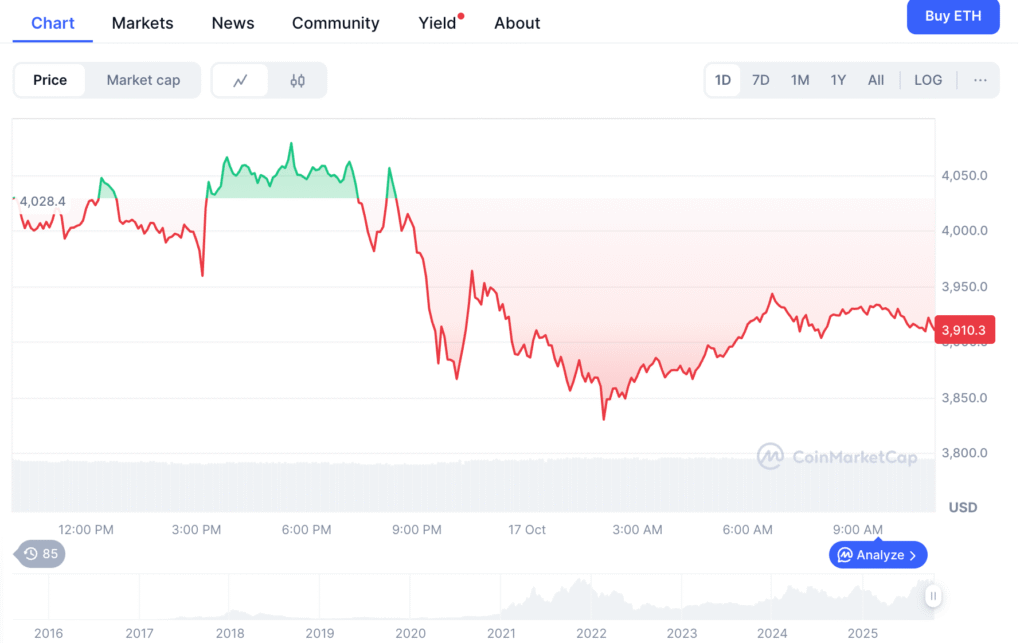
Meanwhile, Ethereum is trading at $3,918.65, down by 2.22% in the last 24 hours. The global market cap is at $473.03 billion. The 24-hour trading volume is still up by 2.64%.
The increase in activity is thought to indicate that retail is making a comeback. While whales continued to amass, retail had all but abandoned Ethereum in the last few quarters.
Users are now returning to the most popular applications, indicating a change in attitude in Ethereum activity. The top three smart contracts on the Ethereum network are USDT, USDC, and straightforward ETH transfers, depending on gas use.
Other developments
PeerDAS, the key component of Fusaka, according to Vitalik Buterin, will enable Ethereum nodes to verify and recreate blocks without retaining all the data. He commented as the community prepares for the Fusaka update on the Ethereum mainnet on Dec. 3.
By allowing nodes to confirm data availability using only fragments of each block, the modification seeks to aid Layer 2 scalability now and perhaps Layer 1 eventually.
Also, Bhutan is moving its National Digital Identity (NDI) system from Polygon to Ethereum as the South Asian nation continues to strive for blockchain innovation.
After Leary’s comment, the gas fee problem is going to put a lot of pressure on Ethereum developers. The chain needs to come up with a solution so that it maintains the trust of the community and serves its needs.
Also Read: SWIFT Confirms Ethereum’s Linea As Base For New Blockchain Payments Platform