
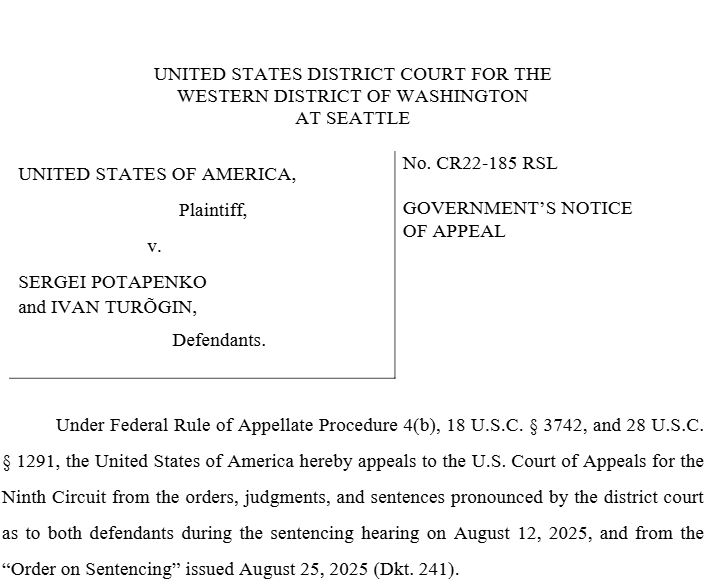
The U.S. Appeals Court is to rehear the sentences of Sergei Potapenko and Ivan Turõgin, who were co-founders of crypto mining service HashFlare that went out of business, after prosecutors objected to what they termed as excessively lenient sentences.
The two men had earlier been given time served, a $25,000 fine, and 360 hours of community service upon their guilty pleas to conspiracy to commit wire fraud.
Prosecutors argue that the enormity of the $577 million Ponzi scheme warrants a minimum sentence of 10 years in prison, describing it as one of the most significant fraud cases ever prosecuted in the federal court of Seattle.
Prosecutors Emphasize Scope of the HashFlare Fraud
HashFlare raised over $577 million from 2015 to 2019 by selling cloud mining to investors.
Prosecutors added that the firm generated fraudulent dashboards, which exaggerated its mining capacity and artificially inflated returns.
The scheme was a classic Ponzi scheme, where payouts to early investors were offset by payouts from newer customers rather than profits from actual mining.
The government contends that the scheme did “serious harm” to thousands of victims who, in some cases, lost significant savings and therefore merited harsher sentences than those imposed by Judge Robert Lasnik.
Also Read: US Judge Orders EminiFX Founder Eddy Alexandre To Pay $228M+ In Restitution and 9-year Prison Term
Defense Arguments Cite Investor Repayment and Asset Forfeiture
On their part, lawyers acting on behalf of Potapenko and Turõgin argued that although HashFlare overestimated its operational capacity, clients also gained cryptocurrency that was worth more than they had invested due to the subsequent increase in digital asset values.
The defense further indicated that victims will be compensated in full by more than $400 million worth of assets seized in the founders’ plea deal in February.
Notably, prosecutors denied these assertions, insisting that many of the details provided were fabricated and did not accurately reflect the full extent of the losses incurred by investors.
Also Read: Terraform Labs’s Do Kwon Pleads Guilty To U.S. Fraud Charges Over $40B Crypto Collapse
Crypto Crime Enforcement Under Scrutiny
This case has sparked further debate about the appropriateness of sanctioning white-collar crimes in the cryptocurrency space.
Blockchain experts and officials combating money laundering are concerned that lenient sentences in the past will provide incentives for more crime, as they may lead criminals to believe they can operate without consequence.
Critics believe that the gaps in enforcement accountability, which fail to prosecute under the law, violate assurances to investors and reward scam operations that take advantage of the gaps in regulation, insurance, and assurance in the burgeoning cryptocurrency industry.
The government is trying to ramp up the punishment, which some feel is essential, because they want to be “bigger” in issuing a precedent for mass-scale fraud in their crypto market.
Comparisons with Other High-Profile Cryptocurrency Cases
The HashFlare sentencing scandal comes at a time when there are mounting challenges to sentences handed down in high-profile crypto fraud cases.
For instance, in May, FTX founder Sam Bankman-Fried had four years cut from his prison sentence recently under federal sentencing reduction programs, UnoCrypto reported.
At the same time, his former colleague, Caroline Ellison, who cooperated with prosecutors, is set to be released in 2026 after serving just two years.
The various cases outlined show the disparity in sentencing that can occur based on cooperation with authorities, participation in rehabilitation programs, and judicial discretion.
The HashFlare Appeals Court ruling will be closely watched as a benchmark for how U.S. courts handle high-profile crypto fraud in the future.
Also Read: South Korean Crypto Exchange Bitsonic CEO Sentenced to Second Prison Term Following Major Fraud Case