
Arcadia Finance has become the latest victim in a string of decentralized finance (DeFi) exploits, losing approximately $2.5 million in a sophisticated cyberattack.
According to real-time monitoring by blockchain security firm PeckShield, the attacker managed to exploit Arcadia through unauthorized transactions involving a component called the “Rebalancer.”
The stolen funds were rapidly swapped for approximately 840 ETH and bridged from the Base Layer 2 network to the Ethereum mainnet.
The swift cross-chain movement is a common tactic used by hackers to obfuscate stolen assets and complicate recovery efforts.
Details of the Attack: Movement of Funds and Techniques Used
Blockchain data shows that the attacker executed a series of transactions to launder and distribute the stolen funds.
Initially funded by a Tornado Cash transaction, the malicious actor sent 1 ETH to kick-start the exploit.
Once the hack was completed, the attacker transferred 839.3 ETH (worth around $2.49 million at the time) to a single wallet.
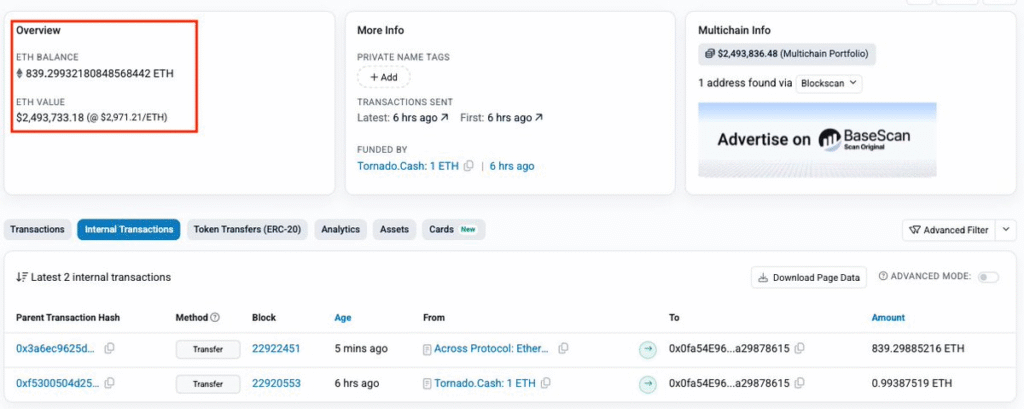
Also, they used protocols like Across and other bridge services to migrate the funds out of the Base network.
Tornado Cash, a well-known privacy protocol, was then used to obscure the source of funds, making them difficult to trace and increasing the likelihood that the assets will never be recovered.
Also Read: Microsoft Wipes Thousands Of North Korean IT Worker Fraud Accounts Amid Rising Crypto Hacks
Arcadia Finance Responds: Urgent User Instructions Issued
In response to the incident, Arcadia Finance issued a series of urgent posts on X advising users to revoke all permissions granted to asset managers and immediately disable any active or legacy Rebalancers.
The team confirmed they were actively investigating the breach and promised more details in due course.
Their transparency and swift user outreach mark an important first step in damage control.
However, the scale of the exploit raises serious questions about smart contract vulnerabilities and the security framework underpinning Arcadia’s asset management infrastructure.
Wider Industry Impact: One in a Series of Recent DeFi Hacks
The Arcadia exploit is just the latest in a worrying trend of high-profile DeFi attacks.
Recently, GMX on the Arbitrum network suffered a $42 million hack that leveraged social engineering via fake podcast invitations.
Meanwhile in same month, Venus Protocol lost $2 million due to a smart contract vulnerability exploited through MEV bots and insufficient permission controls.
Even larger attacks, like the $8.3 million exploit on Alex Protocol, have forced platforms to introduce reimbursement programs.
These incidents reflect growing risks within decentralized finance, where complex contracts and decentralized control can lead to massive financial losses when exploited.
Also Read: Taiwan’s BitoPro Crypto Exchange Successfully Restores $11 Million Following Major Crypto Hack
Growing Security Concerns Highlight Need for Stronger Safeguards
The Arcadia breach underscores the urgent need for improved security protocols and smart contract auditing across the DeFi landscape.
The use of privacy tools like Tornado Cash and bridging protocols not only accelerates the laundering process but also limits the scope of post-attack forensic tracing.
As more funds move into decentralized protocols, developers are being called upon to implement multi-layered security, thorough permission audits, and real-time monitoring systems.
For users, the attack is a stark reminder to regularly revoke permissions and stay informed on project security updates.
As the DeFi ecosystem expands, so does its attack surface, making resilience and proactive protection more critical than ever.