

The number of Ethereum ($ETH) tokens held on centralized exchanges has fallen to 8.97 million, the lowest amount in more than nine years, according to data from Cryptorank.
This decrease indicates a substantial change in the trading and storage of ETH. The supply on centralized exchanges keeps declining as more Ethereum is staked or kept in self-custodial wallets and decentralized finance (DeFi) platforms gain popularity.
This pattern suggests that, particularly in light of recent security lapses and regulatory worries, investors are growing more hesitant to leave their assets on exchanges.
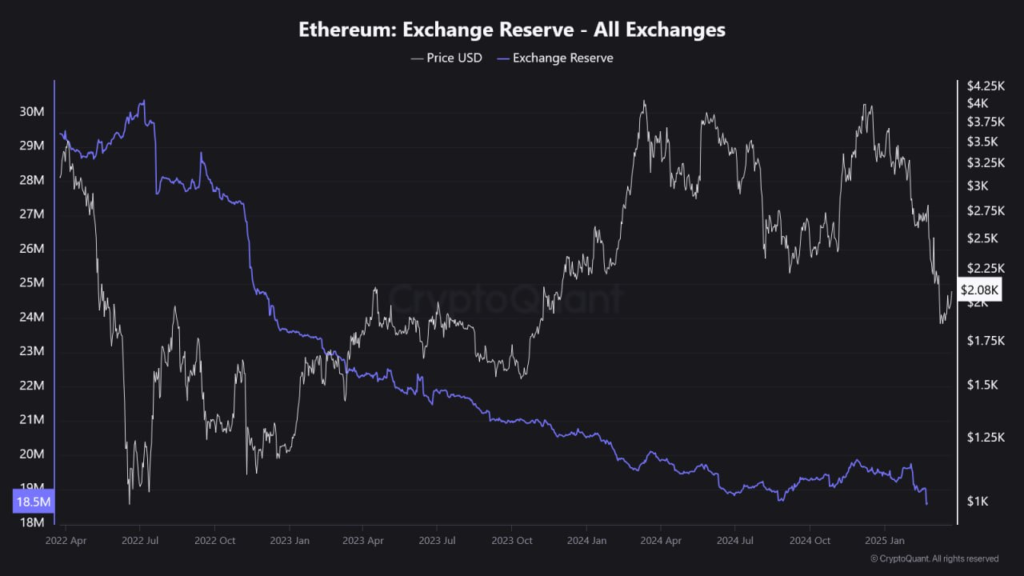
ETH Scarcity on CEX Can Help With Price Rise
As demand exceeds supply, the decline in centralized exchanges’ ETH holdings may result in more scarcity and a spike in price.
It also represents a larger trend in the cryptocurrency space toward decentralization and more asset control.
The pattern shows that self-custody solutions are becoming more and more popular, and it may also portend a change in how investors use Ethereum in the future.
When paired with stable or increasing demand, this supply drop may create a scarcity effect that drives up prices. Large sell orders find it more difficult to influence the market when there are less coins available on exchanges, which pushes prices higher.
Also Read: Ethereum Holds Support At $1,886–$1,944 As 3M Investors Accumulate 6.12M ETH
Crypto Shortage on CEX Not Only Limited to ETH
The crypto market is undergoing a noticeable change as a result of the continuous withdrawal of coins from centralized trading platforms.
Coin availability on centralized exchanges keeps declining as investors shift their holdings more and more to self-custody wallets or decentralized finance (DeFi) platforms.
With Ethereum ($ETH) and Bitcoin ($BTC), where the quantity of currency kept on exchanges has drastically decreased, this trend is especially noticeable.
A bullish attitude may also be bolstered by the migration of assets off exchanges, which indicates a growing faith in decentralization and long-term investing methods. In the upcoming months, this tendency might be crucial in pushing cryptocurrency prices upward.
Bitcoin’s Past Price Suggests A Price Rise After Shortage
A change in investor behavior was indicated on January 13 when the quantity of Bitcoin (BTC) held on centralized exchanges fell to a seven-year low.
This decrease in supply on exchanges is a result of customers shifting their assets to decentralized platforms or self-custodial wallets due to security and control concerns.
The price of Bitcoin then experienced a sharp increase after this drop in exchange reserves, rising from about $90,000 to over $109,000 in the days that followed. Because fewer coins were easily accessible for purchase, the scarcity effect caused prices to rise as the amount of Bitcoin available on exchanges decreased.
Also Read: Ethereum Whale Nets $65.68M In Profit After Offloading 34,125 ETH for $67.18M After Eight Years


 coins on CEX, the lowest in almost nine years.)