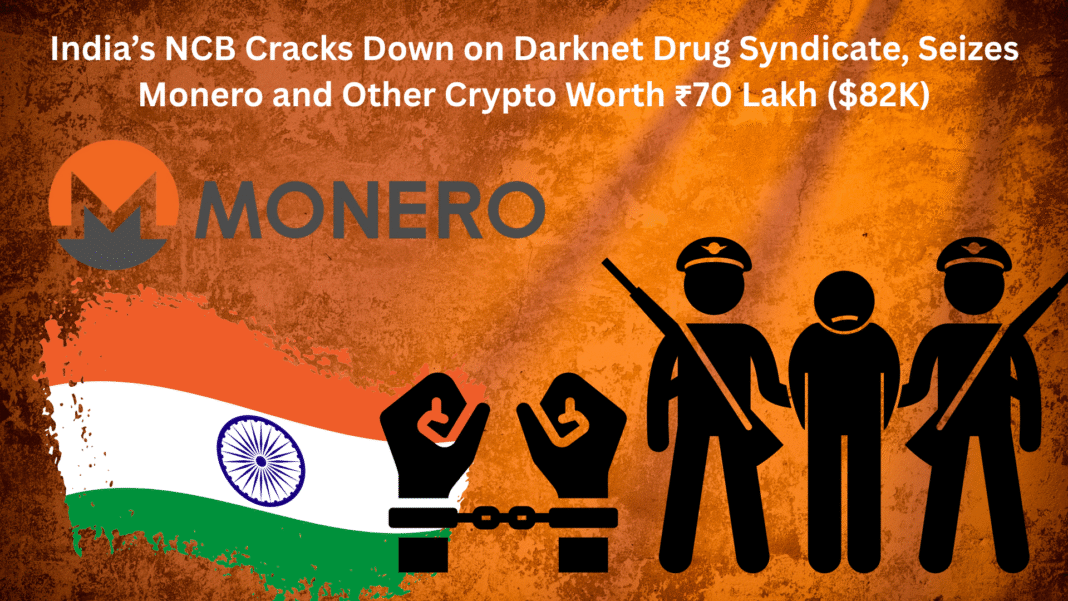


India’s Narcotics Control Bureau (NCB) has arrested a 35-year-old mechanical engineer from Kerala, accusing him of operating what is being described as the country’s most prolific darknet drug syndicate.
The man, identified as 35 year 35-year-old Edison and hailing from Muvattupuzha, was apprehended under an operation codenamed “MELON.”
According to officials, he single-handedly managed a sprawling darknet-based narcotics distribution network that spanned multiple states and operated undetected for years — even his family was unaware of his illegal activities.
Edison Used Privacy Coin Monero (XMR) to Obscure Transactions and Evade Detection
A key part of Edison’s operation involved the use of privacy-centric cryptocurrency Monero (XMR), which allowed him to obscure financial transactions and avoid detection.
Unlike transparent blockchains like Bitcoin or Ethereum, Monero offers advanced anonymity features, making it a preferred tool for darknet operators.
The NCB revealed that the engineer used Monero to receive payments for drugs and to launder proceeds via multiple exchanges and crypto wallets.
During the raid, authorities seized 1,127 LSD blots, 131.66 grams of ketamine, and cryptocurrency assets worth over ₹70 lakh (approximately $82,000). The digital evidence gathered during the seizure is currently being analyzed to uncover the full scale of the operation and identify any potential accomplices or buyers.
The incident is a significant milestone in India’s ongoing efforts to crack down on cyber-enabled narcotics trafficking.
The NCB also highlighted that the integration of darknet marketplaces, cryptocurrency payments, and single-handed tech-savvy operators like Edison is creating new challenges for law enforcement — necessitating stronger cyber and blockchain forensics capabilities going forward.
Also Read: India’s RBI Governor Warns Against Crypto Risks Moments After Major Rate Cut Announcement
Edison, aka “Ketamelon,” Was Allegedly India’s Only Level 4 Darknet Drug Vendor, Local Reports Say
According to local media reports, the arrested suspect, Edison, had been operating under the alias “Ketamelon” and was allegedly India’s only “Level 4” darknet drug vendor—a ranking that indicates high sales volume and credibility in darknet marketplaces.
Over the past two years, Edison is believed to have sourced LSD, ketamine, and other narcotics from international suppliers and distributed them across major Indian cities.
He reportedly used the privacy-focused cryptocurrency Monero (XMR) to launder the proceeds, taking advantage of its untraceable features to mask his transactions.
The operation was run entirely by Edison himself, highlighting both the reach and technical sophistication of darknet drug trafficking in India.
Also Read: India’s Tax Authority Issues Notices To Crypto Traders On Unregistered Platforms
NCB’s Four-Month Probe Leads to Arrest of Alleged Mastermind Behind India’s Largest Darknet Drug Syndicate
The Narcotics Control Bureau (NCB) conducted a four-month investigation that led to the arrest of Edison, the alleged mastermind behind India’s largest darknet drug syndicate.
Authorities claim Edison was responsible for over 600 drug consignments sent across various Indian cities, including Bengaluru, Chennai, Delhi, and Himachal Pradesh.
The shipments were carefully disguised and routed through postal and courier services to avoid detection. Investigators used digital forensics, surveillance, and cyber-tracking methods to trace his operations, which relied heavily on encrypted communications and cryptocurrency payments.
The extensive reach and sophistication of the operation highlight the growing challenge of tackling darknet-enabled drug trafficking in India.
Also Read: India’s CBI Busts Transnational Cyber Fraud Ring, Seizes $327K In Crypto