



Ethereum’s on-chain revenue fell sharply in August, even as ETH pushed to new price highs. Token Terminal says revenue dropped 44% month-on-month to $14.1M from $25.6M in July.
Network fees slid 20% to $39.7M from $49.6M. The data points to a split between market price action and the cash flows that flow to ETH holders.
Revenue slumps despite price surge
ETH rallied more than 240% since April and hit a peak of $4,957 on August 24. Still, the money that comes from token burns and fees fell.
On-chain revenue is the cash that benefits people who hold ETH. That number shrinking while price rises has renewed debate over how Ethereum will pay for itself over the long run.
Why fees fell?
Much of the drop traces back to the Dencun upgrade in March 2024. That upgrade cut transaction costs for layer-2 rollups. Lower L2 costs are good for users.
They make transfers cheaper and speed up the network, but they also cut layer-1 fee income. Layer-1 fees used to be a key source of value for ETH holders. With those fees lower, on-chain revenue can fall even when the market price climbs.
Bringing more activity to layer 2s has changed where fees are paid. A lot of trading and transfers now happen off the main chain.
That reduces demand for layer-1 gas, and the result is lower fee revenue and smaller token burns. For some holders, that change means less steady cash flow tied to block activity.
The wider debate
The revenue decline has split views, and the critics say low fee income weakens Ethereum’s economic model. They argue the network may struggle to fund security and long-term work if fee revenue stays low.
Supporters say Ethereum is evolving into the backbone of decentralised finance. They point to growing usage on layer 2s and rising total value locked across the ecosystem.
Both sides note one fact, and price gains do not always match revenue flows. A high ETH price helps holders on paper, but ongoing costs and incentives depend on on-chain fees and burns. That mismatch is now at the centre of talks about how to sustain network security and development.
Institutional interest and new funding
Despite the revenue dip, interest from big players is rising, Etherealise raised $40M in September to push Ethereum adoption among public companies.
The group started in January with backing from the Ethereum Foundation and Vitalik Buterin. It aims to help firms understand Ethereum and build tools they can use.
Co-founder Grant Hummer said many institutions still lack the basics needed to work with ETH. The $40M will fund tools and platforms that fit normal finance workflows.
Etherealize plans to build systems for private trading and settlement of tokenised assets. It is also working on a settlement platform for tokenised bonds and other fixed-income products.
That push shows firms see long-term value in Ethereum even as short-term fee revenue wobbles. Some companies are staking ETH. They lock tokens to earn rewards and help secure the chain. Those moves signal a bet that Ethereum will remain central to crypto finance.
ETH Price Actions
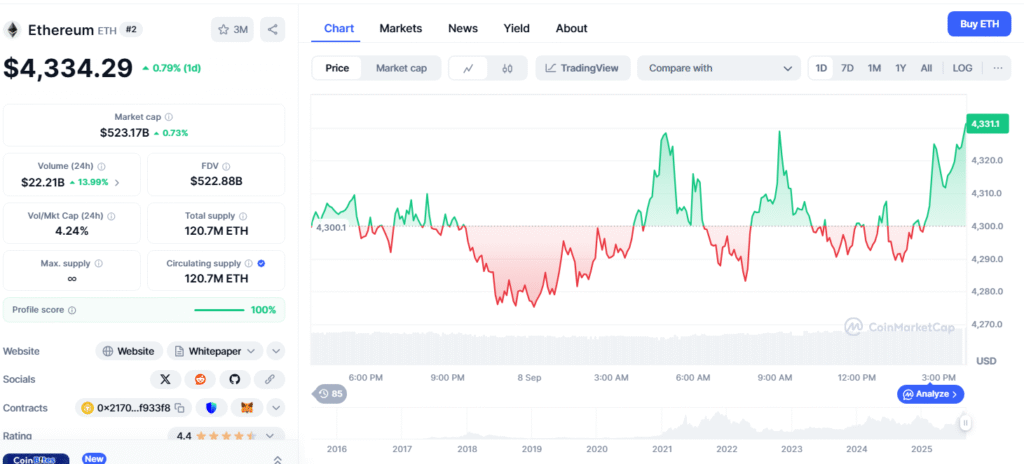
At the time of these figures, ETH was trading at $4,299 and was down 0.03% in the last 24 hours. The global market cap stood at $519.2B. The 24-hour trading volume was 10.89%. Markets remain active even as the revenue story shifts.
Lower fee income may reduce the steady cash flows tied to holding ETH. That could influence how developers and validators view their incentives.
It may also shape future upgrades and proposals that try to balance low user costs with healthy network economics.
At the same time, cheaper layer-2 fees can spur more real use. More users may move on-chain activity to layer 2, and that could lead to new applications and more total value over time.
The trade-off between cheaper use today and sustained income for the base layer is now a key policy discussion.
Ethereum faces a new phase, and the network has won big on price and on user scale. But the money that comes from on-chain fees has fallen. That gap has sparked a debate about how Ethereum pays for its future.