




Ethereum co-founder Vitalik Buterin has confirmed Ethereum’s milestone of having been in operation for 10 straight years and not even a minute of downtime.
Retweeting the tweet that had mentioned the milestone, Vitalik has in effect validated the comments regarding the uptime and consistency of Ethereum since launch.

Unlike other centralized networks that plan their downtime or windows of downtime or manual actions, the Ethereum Network has remained resilient in its operation.
Regardless of the fork, crash, litigation, or major global incident, there was never a need for the Ethereum blockchain to stop.
That goes to prove the theory behind the concept of decentralization and the presence of a decentralized global community committed to it.
A Decentralized Triumph Amid Centralized Failures
The post retweeted highlighted stark contrasts with leading centralized infrastructure providers, which have had major outages.
For instance, as reflected in the tweet, Facebook experienced a 14-hour outage in the past, AWS Kinesis was down for 17 hours, and Cloudflare lost 19 data centers in a single incident.
Also, the majority of alternative Layer 1 blockchains (alt L1s) have had constant disruptions and network shutdowns at various points.
These parallels form the basis of the idea that Ethereum’s uptime is not a technical feat, but a victory of philosophy.
Its uninterrupted operation does not depend on a CEO, a 24/7 support team, or a manual watch, but on the cooperative effort of developers, stakers, researchers, and users worldwide.
They all contribute to making the network robust and resilient and shaping it.
Ethereum’s Price Rises as Network Resilience Bolsters Market Confidence
Ethereum’s strength when it comes to technical performance and social reaction is exhibited by its price action lately.
Ethereum price is currently at $3,932.42, signaling a 3.59% increase in the last 24 hours and a 4.59% in the last seven days.

The bounce has given Ethereum’s price a total market capitalization of a gigantic $474.8 billion, supported by a circulating supply of 120 million ETH.
The long-term stability of the network has become a source of strength, enabling ETH to maintain investor confidence even during volatile market phases.
Their reputation as a well-tested and decentralized infrastructure is perhaps the strongest distinguishing factor for Ethereum amongst the broader spectrum of cryptos.
Open Interest and RSI Indicate Strong Bullish Momentum
Market indicators reinforce the growing demand for Ethereum among new investors.
Open interest within ETH futures increased by 8.18% within the past 24 hours, to $28.2 billion, as a sign of increasing participation and conviction in the bullish trend of the asset.
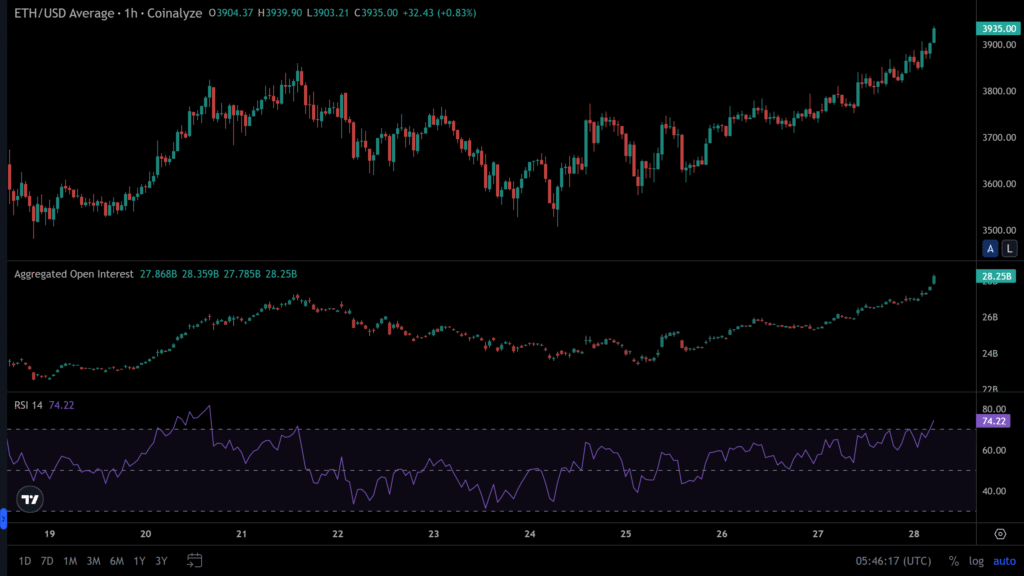
Additionally, the RSI indicator for the ETH token has risen into the bullish range of 70, indicating bullish momentum in the market.
Such technical indicators demonstrate, therefore, that strong trading activity volume and rising conviction in the market currently underwrite ether-trading price action.
Ethereum is poised to appreciate further in the near term, as more players enter the markets on both the derivative and spot sides.
Also Read: Ethereum Co-Founder Vitalik Outlines Four Pillars Of Sustainable And Scalable L1 Blockchains
A Decade of Continuity Indicative of a Decentralized Future
The decade of ten years of uptime for Ethereum stands as a testament to what decentralization can achieve with an intentionally coordinated community spread worldwide.
It lacked a central authority to save it, and instead, it had to suffer through periods of technological adversity, regulatory disapproval, and market meltdowns.
Vitalik’s retweet is more than just an appreciation and serves as a reminder that Ethereum’s resilience rests on people and ethos.
As Ethereum reclaims $3,900 price zone, those 10 years of uptime stand as a shining example of what decentralized systems can offer to a world that craves reliability and autonomy.