

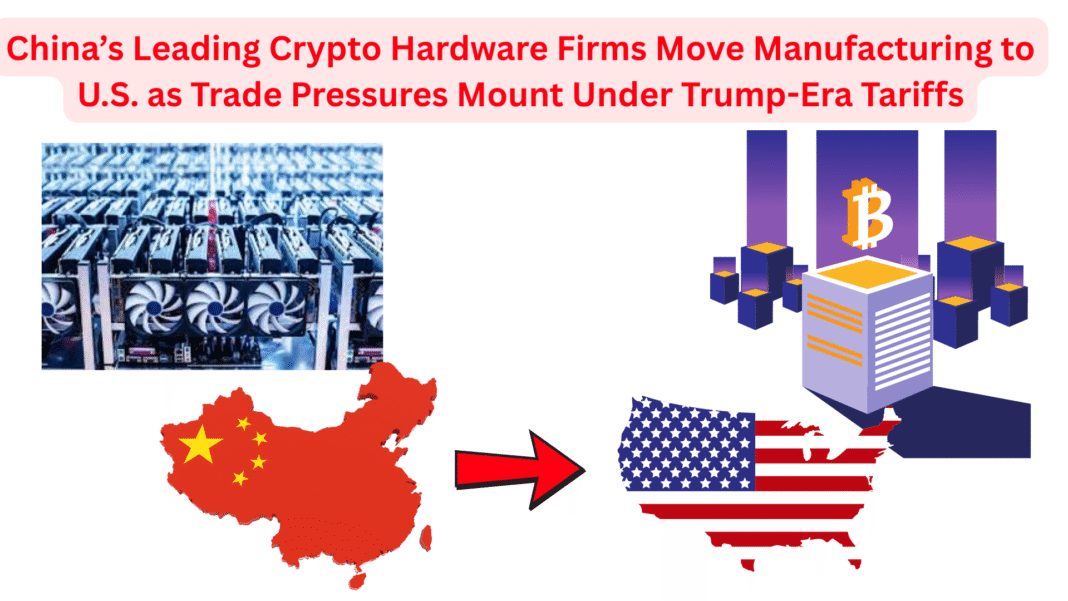


The world’s top three Bitcoin mining machine manufacturers—Bitmain, Canaan, and MicroBT—have established production facilities in the United States to sidestep newly imposed tariffs by the Trump administration.
According to Reuters, these companies, all headquartered in China, collectively dominate over 90% of the global crypto mining hardware market.
The move marks a strategic shift in global crypto infrastructure manufacturing and reflects the growing influence of geopolitical and trade tensions on the crypto industry.
Chinese Mining Giants Shift Production to U.S. to Cut Costs and Bypass Tariffs
By relocating production to the U.S., these firms aim to reduce costs and maintain their competitive edge in the face of stiff tariffs on Chinese-made technology products.
The decision also allows them to better serve the booming North American mining sector, which has expanded rapidly due to favorable energy prices and regulatory clarity in certain regions.
This shift not only mitigates the financial impact of tariffs but also signals the increasing globalization of the crypto mining supply chain.
As the U.S. cements its position as a leading hub for Bitcoin mining operations, domestic manufacturing of mining equipment could enhance logistical efficiency and reduce shipping times.
The presence of Chinese crypto hardware giants on American soil also underscores the industry’s adaptive nature in navigating complex global trade dynamics.
Also Read: Hut 8 Partners with Eric Trump to Launch American Bitcoin Mining Company
U.S.-China Trade War Sparks Structural Shifts in Bitcoin Mining Supply Chains
The U.S.-China trade war is driving deeper, structural shifts in Bitcoin mining supply chains, according to Guang Yang, CTO of Conflux Network.
He emphasized that for U.S. companies, this shift isn’t just about avoiding tariffs but also about sourcing hardware from “politically acceptable” origins.
Bitmain, the largest mining rig maker by sales, began U.S. production in December—a month after Donald Trump won the presidential election—as a strategic move.
Meanwhile, Canaan has started trial production in the U.S. to sidestep Trump’s “Liberation Day” tariffs announced in April.
However, Canaan views this move cautiously, with executive Leo Wang noting that the unpredictable tariff environment makes large-scale investment risky for now.
Also Read: Kuwait Bans Bitcoin Mining Amid Soaring Energy Demands
China’s Sees Faded Dominance in Bitcoin Mining an Production
China once held a commanding position across the entire Bitcoin value chain, from manufacturing mining rigs and running large-scale mining operations to leading global crypto trading volumes.
This dominance was largely due to access to cheap electricity, tech expertise, and a favorable early regulatory environment.
However, in 2021, the Chinese government imposed a sweeping ban on cryptocurrency-related activities, citing threats to financial stability, energy consumption concerns, and the risk of illicit financial flows.
The crackdown forced mining operations to shut down or relocate abroad, especially to North America and Central Asia.
It also pushed Chinese crypto firms to adapt by moving their infrastructure and operations offshore, leading to a significant reshaping of the global crypto industry landscape.
Also Read: Tether CEO Announces Plans to Open-Source Its Bitcoin Mining Operating System (MOS)