
In a recent development, report has been released that a Venus Protocol user lost about $27 million in digital assets to a phishing attack.
The attacker tricked the victim into approving a malicious smart contract that allowed the hacker the power to move funds within the wallet.
The address of the attacker, 0x7fd8…202a was given unlimited spending power and could drain assets without the victim being involved in further transactions.
This incident exemplifies the ongoing risk of social engineering found in decentralized finance (DeFi).
Breakdown of Stolen Assets
On-chain data indicates that the attacker drained an aggregate of total of $27,148,756.95 from the protocol in six different assets.
The majority was represented by $19.82 million in Venus USDT (vUSDT) and $7.15 million in Venus USDC (vUSDC).
Additionally, there was a loss of about $146,000 in Binance-Peg XRP and $22,000 in Binance-Peg ETH.
Notably, Venus protocol was not the reason for the hack. Still, rather an exploit of token approvals, where granting access rights to a malicious smart contract effectively gave the attacker control over the victim’s holdings.
How the Attack Happened?
Once the malicious contract was approved, the victim unknowingly permitted the attacker to transfer tokens out of the wallet.
Once the attacker’s approval was granted, they promptly drained the account, wiring assets away to their own address.
This is different than hacks that premeditate an exposure, taking advantage of vulnerabilities in code, as this phishing attack relied on user error, and is therefore much more difficult to identify and stop in the moment.
They demonstrate that an approval subject to restrictions is just as harmful as an exploit of a protocol.
Also Read: CrediX Team Disappears After $4.5M Crypto Hack and Acclaimed Funds Recovery
Broader Implications for DeFi Security
This event is deemed to date one of the largest phishing-related DeFi losses of 2025, which does not help build confidence around safety for investors in decentralized markets.
The exploit also emphasizes the importance of revoking certain token approvals no longer in use, the benefits of using security tools like Revoke.cash, and the benefits of using a hardware wallet for larger transactions.
While the Venus Protocol was not hacked, it does call into question whether a warning and perhaps some educational information should be published on every platform regarding approvals.
This situation illustrates the dark side of DeFi; while open approvals are often a valuable feature, they can also be a disaster when misused.
Also Read: Crypto Hackers Exploit SuperRare Staking Contract Of $731K $RARE Tokens, Here’s All
Market and Industry Impact
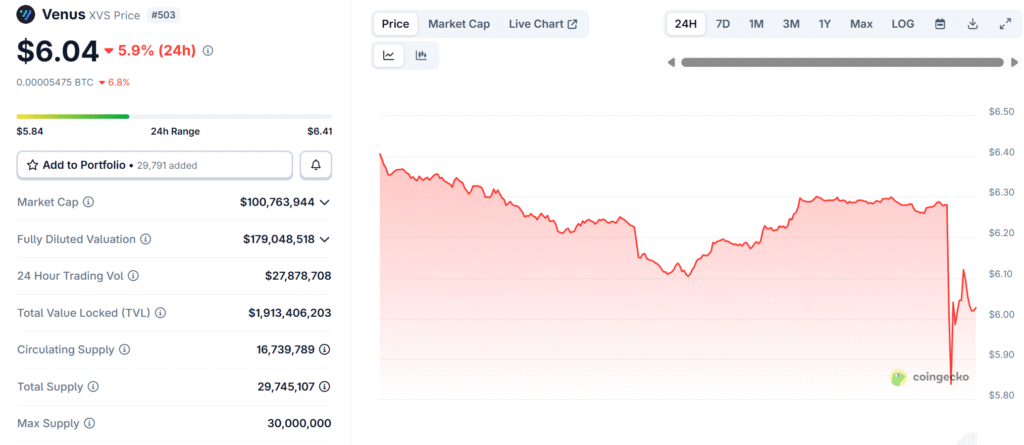
After the news of the phishing exploit, Venus (XVS), the governance token of the Venus Protocol, was on the decline.
The token price fell to $6.04, down -5.71% in the past 24 hours, down -2.78% in the past week, with a total market cap of $100.7 million.
This is even more concerning with DeFi security already under pressure. UnoCrypto reports that in August 2025, the crypto industry experienced $163 million of hacking-related losses, which was 15% higher than July.
With phishing scams, DeFi exploits, and exchange exploits on the rise, this incident highlights the need to adopt a more cautious approach to security in a rapidly deteriorating security environment.
Also Read: Chinese Mining Pool Lubian Loses $3.5 Billion Amid Unnoticed Crypto Hack Four Years Ago, Here’s All