
The net worth of the Trump family jumped by approximately $6 billion following the debut of their new cryptocurrency called the World Liberty Financial (WLFI) token.
The Wall Street Journal reports that former President Donald Trump is identified as “Co-Founder Emeritus,” while Donald Jr., Eric, and Barron Trump are the co-founders of the new project.
The family has just under 25% of all WLFI tokens traded, meaning the asset could be more valuable than their real estate holdings.
While their tokens are currently locked and unable to be sold, the launch of the tokens on multiple major exchanges gives the family tangible valuation for their holding for the first time.
Explosive Market Debut and Investor Frenzy
When WLFI began trading on Monday, the amount of activity was staggering. Trading volume exceeded $1 billion in the first hour of launch, with WLFI tokens trading between $0.24 and $0.30 on Binance.
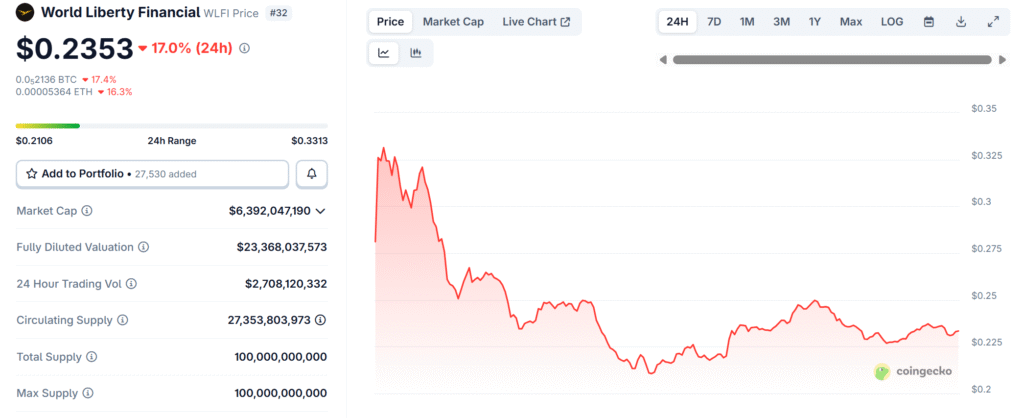
This falls well above the premium early investors originally paid last year, directly from World Liberty at $0.015.
However, early backers are restricted to only trading one-fifth of their holdings, which is intended to limit immediate sell-offs.
The token’s rapid price increase reflects investor enthusiasm; however, market observers have cautioned that any liquidations, even the smallest sell-offs, have the potential to have extreme impacts on the WLFI price, demonstrating the volatility of this newly minted digital asset.
Funding and Business Structure of World Liberty
The World Liberty Financial project was revealed last year during Trump’s White House campaign and support for the cause as “Make America Great again, this time with crypto.”
The family not only created the token but also conducted a takeover of a publicly listed company to do so.
Also, World Liberty raised $750 million from external investors to support the launch of WLFI.
The family could earn as much as $500 million from token sales, because the Trump family retains three-quarters of the revenue from the token sales.
While it’s clearly a commercial enterprise, there are questions about whether political power could be combined with business interests, which the White House completely denies.
Also Read: Trump Family’s WLFI Acquires BuildOn Token, $B Price Shoots Up 455%
Governance Proposal and Supply Reduction Strategy
In reaction to large early losses among WLFI investors, World Liberty Financial has announced a governance proposal aimed at stabilizing the token’s price through supply reduction.
The proposal would use 100% of protocol fees earned from liquidity pools on Ethereum, BNB Chain, and Solana to buy back and permanently burn WLFI tokens.
If the proposal were to be approved, it would create a process for the regulated purchasing of tokens, allowing a controlled reduction in the circulating supply and, therefore, increased scarcity, presumably leading to a higher price in the marketplace.
While the proposal aligns with other supply reduction mechanisms in DeFi, naysayers are concerned that it may not be significant enough to appease investors, especially given WLFI’s politically-focused brand.
Also Read: Trump Family Backed WLFI Grants Approval for Making $WLFI Tradable Amid Major Governance Decision
Cybersecurity Risks and Investor Panic
Although the launch was highly praised, WLFI has faced a number of serious issues, especially related to security.
Reports indicate that hackers are compromising WLFI token holders due to Ethereum’s EIP-7702 malfunction, according to UnoCrypto.
Though the hackers utilized multiple instances of delegate contracts, the actors siphoned funds from the wallets of investors: in other words, funds were seized, trust was lost, and the hypothesis of a security structure fell apart.
WLFI’s market performance has suffered due to the incidents, with some investors selling under panic conditions due to worst-case scenario fears of continued cyberattacks.
Although World Liberty executives, including CEO Zach Witkoff (the son of Trump’s Middle East envoy Steve Witkoff), have continually repeated the non-political mission of the project.
They have the immediate goal of restoring trust in their investors and assuring they are addressing areas of vulnerability that could undermine momentum.