

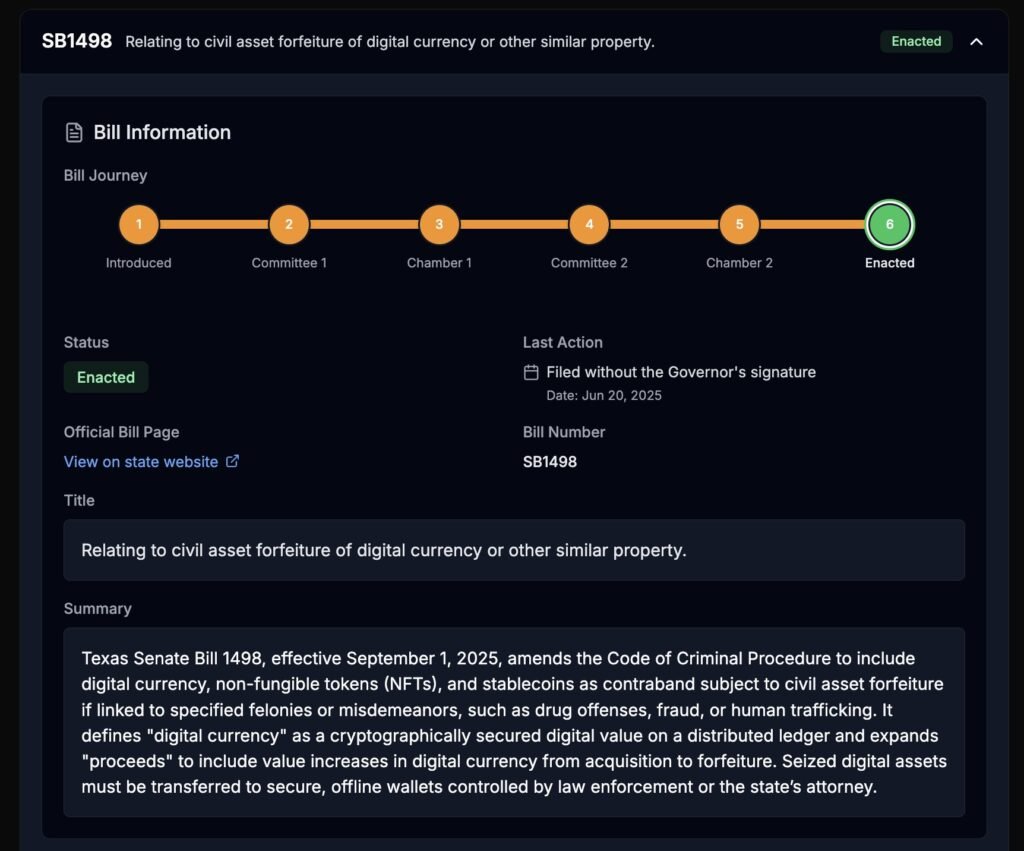
Texas has taken a significant step toward regulating digital assets in criminal investigations by passing Senate Bill 1498, a bipartisan law that grants law enforcement the authority to seize cryptocurrencies and other digital assets linked to criminal activity.
Signed into law on June 20, the measure is set to take effect on September 1, 2025.
What Does The New Law Say?
Under this new law, Texas authorities will be empowered to confiscate assets such as Bitcoin, stablecoins, non-fungible tokens (NFTs), and other forms of cryptocurrency if they are determined to be connected to illegal activities like fraud, money laundering, or cybercrime.
The bill aims to modernize the legal system’s response to the rising use of digital assets in criminal operations, closing gaps in current enforcement procedures.
Supporters of the bill argue that as cryptocurrency adoption grows, so too does its misuse by bad actors, making such legislation essential for public safety and financial integrity.
By enabling asset recovery, the law aligns Texas with a growing number of jurisdictions developing legal tools to combat crypto-enabled crime.
It also signals the state’s commitment to balancing innovation with regulation, as Texas continues to position itself as a leading hub for both blockchain development and financial compliance.
Texas Passes Bill Granting Police Power to Seize Crypto in Criminal Cases
The passage of Texas Senate Bill 1498 marks a pivotal moment for crypto regulation in the U.S., granting law enforcement the power to seize digital assets linked to criminal activity.
This move is expected to strengthen the legal system’s ability to combat crypto-related crimes, such as fraud, money laundering, and cyber theft.
It also brings greater accountability and oversight to a space often criticized for its lack of regulation. For crypto users and firms operating in Texas, the law underscores the need for enhanced compliance and transparency.
While it may deter criminal misuse of crypto, it also raises questions about how digital assets will be identified, frozen, and secured during investigations—potentially setting a precedent for other U.S. states to follow.
Also Read: Texas Senator Introduces Bill To Create Strategic Bitcoin Reserve, Will Others Follow Suit?
Texas Becomes First U.S. State to Buy Bitcoin Using Public Funds
The new comes against the backdrop of Texas becoming the first state in the United States to use public monies to buy Bitcoin on June 22, 2025, when Governor Greg Abbott signed Senate Bill 21 into law.
Ten million dollars will be set aside by the state to create a stand-alone Strategic Bitcoin Reserve that will be run independently of its main treasury.
HB 4488, a related law, guarantees that these Bitcoin assets are protected and cannot be moved to the state’s primary budget.
Texas is positioned as a leader in the adoption of cryptocurrency in the public sector thanks to this expenditure, which is modest at around 0.0004% of the state’s overall budget but shows a strong move toward accepting digital assets.
It may encourage other governments to do the same since it shows growing faith in Bitcoin’s status as a sovereign reserve asset.
Also Read: US SEC Dismisses Quest to Regulate DeFi Market, What’s Next For The Industry?