

The global financial landscape was rocked on what is now being called “Black Monday,” following former President Donald Trump’s declaration of “Liberation Day” and the escalation of a global tariff war.
The dramatic shift sent shockwaves through major economies including China, Japan, Taiwan, the UK, and Germany.
As new tariffs and countermeasures intensified, investor confidence plummeted, prompting a second consecutive day of 10% declines across global stock markets.
The sustained drop has only been seen four times in modern history, during the Black Friday crash of 1987, the 2008 housing crisis, the COVID-19 pandemic in March 2020, and now April 2025.
Analysts are now questioning whether this 2025 tariff standoff could mark the beginning of a prolonged bear cycle in both traditional and digital markets.
Bitcoin Tumbles to $75K as Crypto Mirrors Traditional Market Fallout
The cryptocurrency market was not spared from the widespread financial fallout. Bitcoin (BTC), often seen as a hedge against traditional market instability, has fallen to $75,184.05, marking a 9.47% drop in the last 24 hours and a 7.74% decline over the past week.
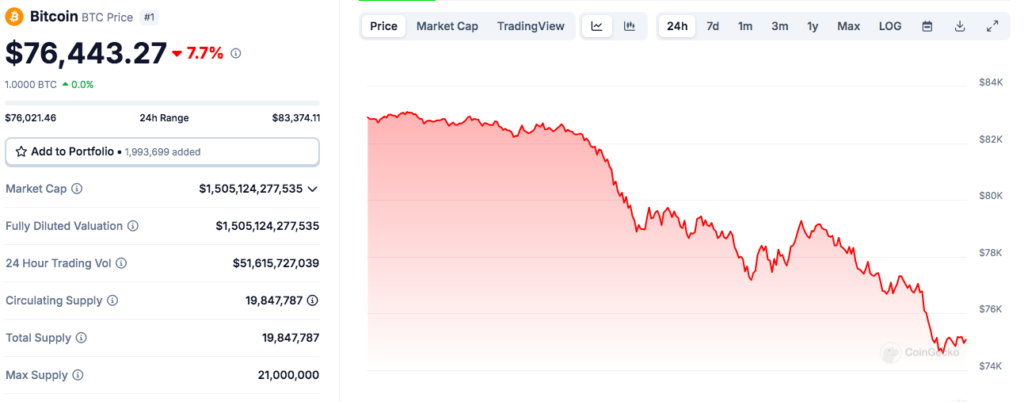
The daily trading volume surged past $51.6 billion as panic selling gripped investors. Ethereum (ETH), the second-largest cryptocurrency, fared even worse, plummeting nearly 19% over 24 hours to $1,459.22.
Its weekly losses now stand at over 19%, reflecting a broader sentiment of fear and uncertainty.
With such large declines across the board, including double-digit losses for Solana and Ripple, the once-resilient crypto sector is showing signs of vulnerability under macroeconomic pressure.
Also Read: Binance Founder CZ Advises Caution Amid Bitcoin Crash, Urges Investors To Focus On Mental Stability
Centralization Concerns Deepen as Institutional Control Grows in Crypto
This recent crash has also reignited debates around the growing centralization of the cryptocurrency market.
What was once hailed as a decentralized alternative to traditional finance now sees a significant concentration of ownership.
MicroStrategy, a long-time Bitcoin bull, currently holds over 500,000 BTC, roughly 2.25% of the total supply, after years of accumulation that began following the COVID-induced 2020 crash.
In addition, BlackRock’s IBIT fund reportedly holds a comparable amount of BTC through institutional investment vehicles.
The concentration of holdings among just a few corporate giants has led many to question whether the crypto market can still operate independently of centralized influence.
As the correlation between the crypto and stock markets strengthens, more analysts warn that crypto may no longer serve as a reliable hedge during economic downturns.
Market Outlook Turns Grim Amid Fears of Further Collapse
Investor sentiment has sharply deteriorated as forecasts indicate that global stock markets may fall an additional 15% to 20% in the coming weeks.
The grim outlook is now weighing heavily on the crypto sector, which traditionally found strength during times of fiat market instability.
However, the current macroeconomic environment, exacerbated by escalating tariffs and political uncertainty, appears to be dragging crypto down alongside equities.
With institutions now holding a dominant share of leading crypto assets, and a tightening correlation between markets, the belief that digital currencies offer a safe haven is rapidly fading.
As both markets brace for further losses, the possibility of entering a full-scale bear market looms larger by the day.